A Label Owner's Guide to Royalty Splits
Royalty splits explained: common structures from 80/20 to 50/50, the real math behind 1M streams, and best practices for label owners. Free guide inside.

Royalty splits determine how every dollar of music revenue gets divided between your label, artists, producers, and other contributors. Get them wrong, and you face disputes, lost artists, and legal headaches. Get them right, and you build the trust that keeps your roster together.
This is royalty splits explained for label owners: how splits work, the most common structures, the real math behind a stream becoming a payment, and best practices for running your label cleanly.
How Royalty Splits Work
At its core, a royalty split is an agreement about who gets what percentage of the revenue a song or recording generates. But splits aren't as simple as dividing a single payment. Revenue flows through several layers before anyone gets paid, and different types of rights create different revenue streams.
The Revenue Flow
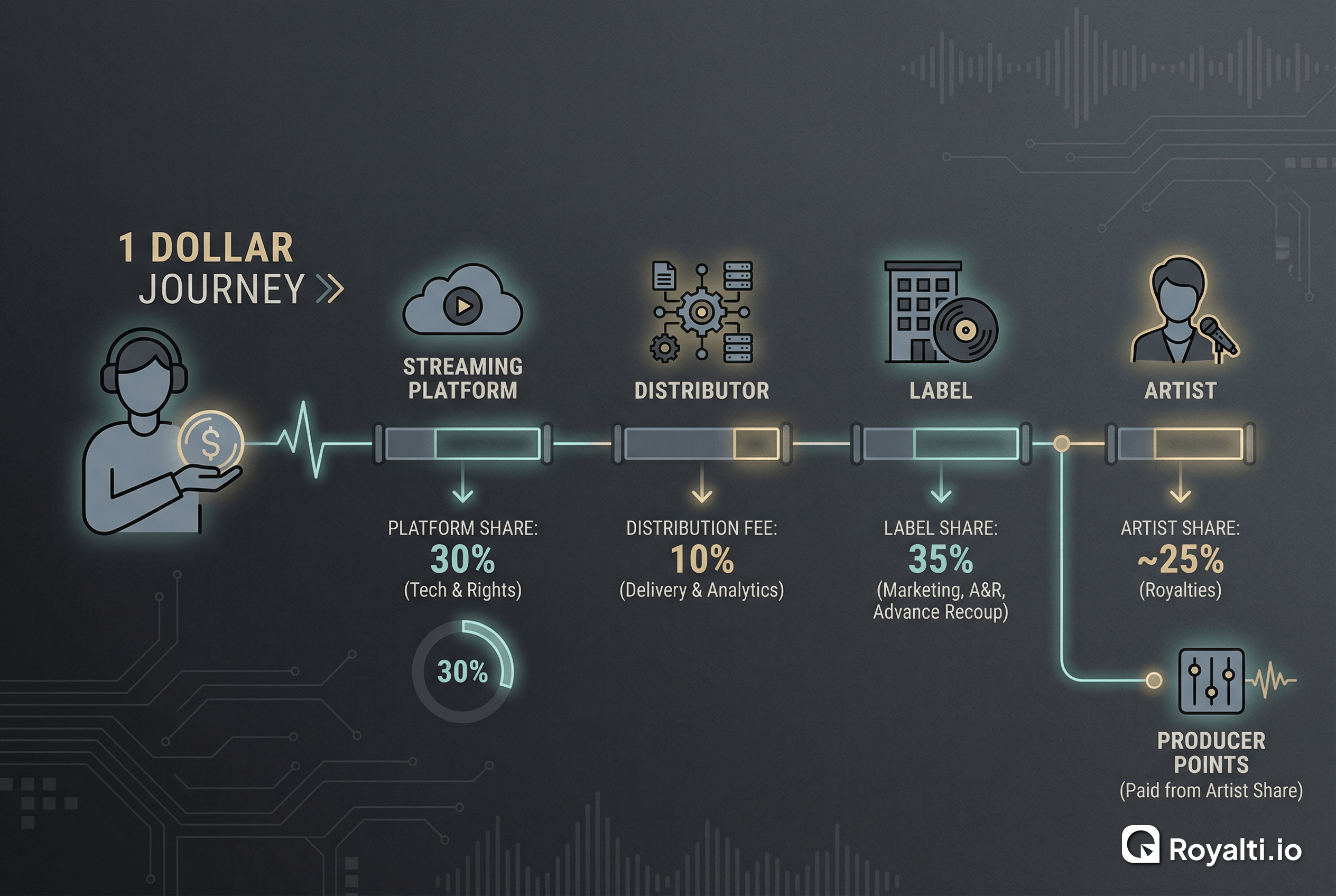
When someone streams a song, the money doesn't go directly to the artist. It follows a chain:
- DSP collects revenue (Spotify, Apple Music, etc. earn from subscriptions and ads)
- DSP pays out a portion as royalties to rights holders
- Distributor takes a cut (if applicable) for delivering the music to platforms
- Label receives its share based on the distribution agreement
- Label pays artists and producers according to their split agreements
Each step takes time and reduces the total amount. Understanding this flow is essential to setting splits that are fair and transparent.
Master vs Publishing Splits
Not all royalties come from the same rights. This is where many label owners trip up.
Master (recording) royalties are generated by the sound recording itself. When someone streams a song, roughly 80% of the royalty goes to the master rights holder, which is typically the label or the artist who owns the recording.
Publishing (composition) royalties are generated by the underlying song, meaning the melody, lyrics, and musical composition. These make up approximately 20% of streaming royalties and are collected separately through publishers and performing rights organizations (PROs).
As a label owner, your splits typically cover master royalties. Publishing splits are a separate agreement between songwriters and their publishers. Conflating the two is one of the fastest ways to create confusion with your artists. For a deeper look at all seven royalty types, see our Understanding Music Royalty Types guide.
Net Receipts vs Gross Receipts
Your split agreement should specify whether percentages apply to gross or net receipts. The difference matters more than most label owners realize.
- Gross receipts: The total revenue before any deductions. If a song earns $10,000, that's the gross.
- Net receipts: Revenue after deducting agreed-upon costs, such as distribution fees, marketing expenses, or recoupable advances.
A 50/50 split on gross is significantly more favorable to the artist than a 50/50 split on net. If your contracts don't specify which model you're using, you're setting up a dispute.
Recoupment and Timing
If your label advances money to an artist (for recording, marketing, or tour support), you'll typically recoup those costs before the artist's split kicks in.
Example: You advance $20,000 for recording costs. The agreement states a 70/30 split (label/artist) after recoupment. Until that $20,000 is paid back from the artist's 30% share, the artist receives nothing from their split. Once recouped, the 70/30 split applies going forward.
Recoupment terms should be crystal clear in your contracts. Ambiguity about what's recoupable and what isn't is one of the top causes of label-artist disputes.
Common Split Structures
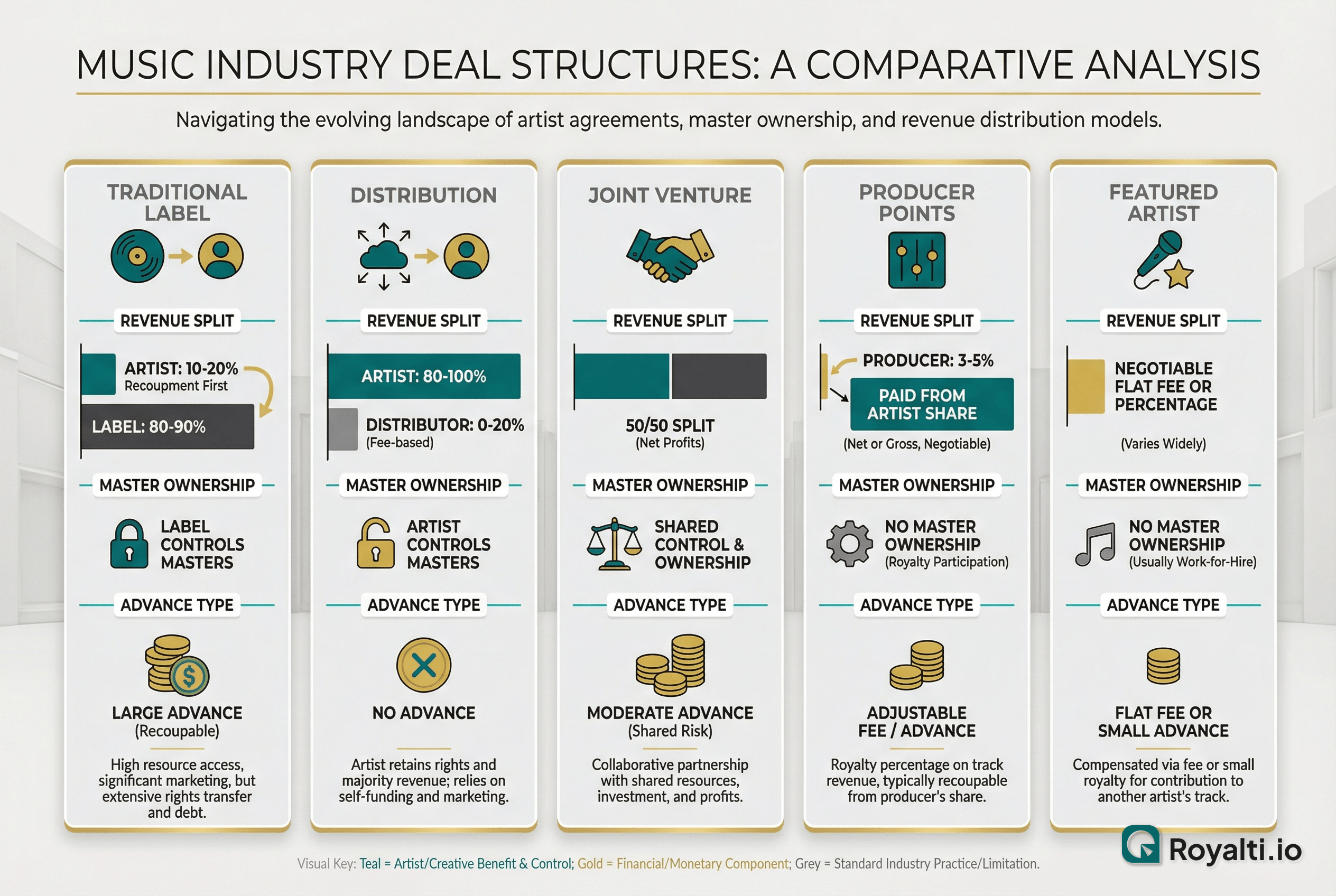
There's no single "correct" split. How to split royalties depends on what your label provides, the artist's leverage, and the type of deal. Here are the five most common models.
Traditional Label Deals
In a traditional deal, the label funds recording, marketing, and distribution in exchange for a larger share of revenue.
- Split range: 80/20 (label/artist) to 50/50
- Typical for: New or developing artists who need funding and infrastructure
- Label provides: Recording advances, marketing budgets, distribution, promotion
- Artist receives: Lower percentage but higher investment in their career
Most modern indie labels land between 60/40 and 50/50, with the 80/20 model becoming increasingly rare outside major label structures.
Distribution Deals
In a distribution-only deal, the artist handles (and funds) everything. The label or distributor simply gets the music onto platforms.
- Split range: 70/30 to 90/10 (artist/label)
- Typical for: Established independent artists who have their own audience
- Label provides: Distribution infrastructure, possibly playlist pitching
- Artist receives: Much higher percentage but bears all costs
Services like DistroKid, TuneCore, and CD Baby operate on this model, often charging a flat annual fee instead of taking a revenue percentage.
Joint Venture and Profit Share
A joint venture (JV) sits between traditional and distribution deals. Both parties invest resources and share profits.
- Split range: Typically 50/50 after costs
- Typical for: Mid-career artists partnering with boutique labels
- Structure: Both parties contribute (label provides marketing, artist provides completed masters), then split net profits equally
- Key difference: Costs are shared or clearly defined before profits are split
JV deals are increasingly popular because they align incentives. Both sides have skin in the game.
Producer Points
Producers are often compensated through "points," a percentage of royalties layered on top of the label-artist split.
- Typical range: 2-5 points (percentage of retail or net revenue)
- How it works: If a producer has 3 points on a track, they receive 3% of the track's net revenue
- Who pays: Usually deducted from the artist's share, though this varies by agreement
- Additional: Producers may also receive an upfront flat fee ($500-$10,000+) as a creative fee
Producer points are calculated after the label-artist split, which means the exact dollar amount depends on the deal structure above it.
Featured Artist Splits
When a featured artist appears on a track, they typically receive a share of that specific track's revenue.
- Typical range: 15-25% of the track's artist share
- Negotiation: Based on the featured artist's profile and contribution
- Application: Applies only to the tracks they appear on, not the full album
- Important: Featured artist splits should be agreed upon before release, not after
The Math Behind Splits
Theory is useful, but numbers make it real. Here's how a single song's streaming revenue actually flows through a split structure.
Walk-Through: 1 Million Streams
Let's say a track on your label hits 1 million Spotify streams. Here's how the money moves:
Step 1: DSP Payment
Spotify pays roughly 70% of its revenue to rights holders and retains 30% as its platform fee. At an average per-stream payout of approximately $0.004, one million streams generates about $4,000 in gross royalties paid out to the recording side.
Step 2: Distributor Cut
Your distributor takes 15% of that $4,000. That's $600, leaving $3,400 in net revenue flowing to the label.
Step 3: Label-Artist Split
Your agreement is 60/40 (label/artist) on net receipts:
- Label share: $3,400 x 60% = $2,040
- Artist share: $3,400 x 40% = $1,360
Step 4: Producer Points
The producer has 3 points (3% of net revenue), deducted from the artist's share:
- Producer share: $3,400 x 3% = $102
- Artist's adjusted share: $1,360 - $102 = $1,258
Final breakdown of the $4,000 payout from 1M streams:
Distributor: $600 (15.0% of Payout)
Label: $2,040 (51.0% of Payout)
Artist: $1,258 (31.5% of Payout)
Producer: $102 (2.5% of Payout)
Total: $4,000 (100%)
Note: This $4,000 is what Spotify pays out after retaining its ~30% platform share. It covers master (recording) royalties only. The songwriter(s) earn publishing royalties separately through their PRO and publisher, which typically account for an additional ~20% of total streaming revenue.
Multiple Contributors
When a track has multiple writers, producers, or featured artists, splits get layered. A song with two co-producers (2 points each) and a featured artist (20% of artist share) could have five or more people receiving revenue from a single stream.
This is exactly where manual calculations in spreadsheets break down. One misplaced decimal or forgotten contributor, and the errors compound across your entire catalog every reporting period. For more on reading and verifying these numbers, see our guide on How to Read Your Royalty Statements.
Territory Variations
Streaming rates vary by country. A stream in the US might generate $0.004, while a stream in India might generate $0.001. If your catalog has international listenership, the same split percentages produce different dollar amounts depending on where your audience is.
This means your reporting needs to account for territory-level data, not just aggregate stream counts. A "million streams" from one country looks very different from a million streams spread across twenty countries.
Where Splits Go Wrong
Even well-intentioned labels run into split problems. Here are the four most common failure points.
Ambiguous Contract Language
"The artist receives 30% of revenue" sounds clear until you ask: 30% of what? Gross or net? Before or after recoupment? Does "revenue" include sync licenses, neighboring rights, and YouTube Content ID?
Vague language is the number one source of royalty disputes. Every split agreement should define exactly which revenue streams are included, whether the split applies to gross or net, and what costs are deducted before the split is calculated.
Missing Revenue Types
Many labels set splits for streaming revenue but forget about sync licensing, neighboring rights, or merchandise revenue sharing. When a song gets placed in a film or TV show, who gets what?
If your split agreement only covers "streaming royalties," you've left a gap that will become a problem the moment a new revenue type appears. For a complete breakdown of all seven revenue types, see Understanding Music Royalty Types.
Manual Calculation Errors
Spreadsheets are the default music royalty split calculator for most indie labels, and 88% of spreadsheets contain errors. When you're calculating splits across dozens of releases, hundreds of tracks, and multiple reporting periods, a single formula error can compound into significant discrepancies.
The problem isn't just the initial mistake. It's that errors in one period carry forward into every subsequent calculation, growing larger over time. By the time someone catches it, you might be dealing with months or years of incorrect payments.
Delayed Payments Erode Trust
Even when your splits are correct, late payments damage the relationship. Artists talk to each other. A reputation for slow or inconsistent payments will cost you signings, regardless of how good your deal terms are.
The Music Business Worldwide and IFPI Global Music Report consistently show that transparency and timely payments are among the top factors artists consider when choosing or staying with a label.
Best Practices for Label Owners
Getting splits right isn't complicated. It requires discipline, consistency, and the right tools.
Document Everything Before Release
Never release a track without a signed split agreement. This includes producer agreements, featured artist terms, and any co-writer splits your label is responsible for managing. Verbal agreements become he-said-she-said disputes faster than you'd expect.
Use Consistent Templates
Create a standard split template for each deal type your label offers. When every agreement follows the same structure, you reduce ambiguity and make it easier to onboard new artists without renegotiating from scratch each time.
Provide Transparent Reporting
Give your artists access to real-time or near-real-time earnings data. When artists can see exactly how their royalties are calculated, disputes drop and trust increases. Opacity breeds suspicion, even when the numbers are correct.
Automate Your Calculations
Manual split calculations don't scale. As your catalog grows, the number of calculations per reporting period increases exponentially. One new release with four contributors across three revenue types means twelve new split calculations every period.
Automation eliminates the human error that compounds over time and frees your team to focus on what actually grows the label: signing artists, promoting releases, and building your catalog.
Build for Scale
The split structure that works for 10 releases won't work for 100. Think about how your processes will hold up as your catalog doubles, then doubles again. The labels growing fastest are the ones that invested in operational infrastructure early.
Frequently Asked Questions
What is a standard royalty split?
There's no single standard. Traditional label deals range from 80/20 to 50/50 (label/artist), while distribution deals are typically 70/30 to 90/10 in the artist's favor. The right split depends on what each party contributes to the release.
How do producer points work?
Producer points are a percentage (typically 2-5%) of a track's net revenue, paid to the producer. They're usually deducted from the artist's share and calculated after the label-artist split is applied. Producers may also receive an upfront flat fee separate from their points.
What's the difference between gross and net royalty splits?
Gross splits apply to total revenue before deductions. Net splits apply after costs like distribution fees and marketing are subtracted. A 50/50 split on gross pays the artist significantly more than 50/50 on net. Your contract should always specify which model applies.
What's Next
This guide covers the fundamentals of royalty splits, but understanding splits is only the first step. The real challenge is operationalizing them across your entire catalog efficiently and accurately.
In our next post, we'll look at How Independent Labels Are Modernizing Royalty Management, including the specific tools and workflows that are saving labels 10+ hours per month on royalty administration.
Want to see how automated split calculations work in practice? Royalti handles split management, artist payments, and transparent reporting for your entire catalog. See your splits calculated automatically across every release.
Related Reading:
About the author
Keep reading
All posts →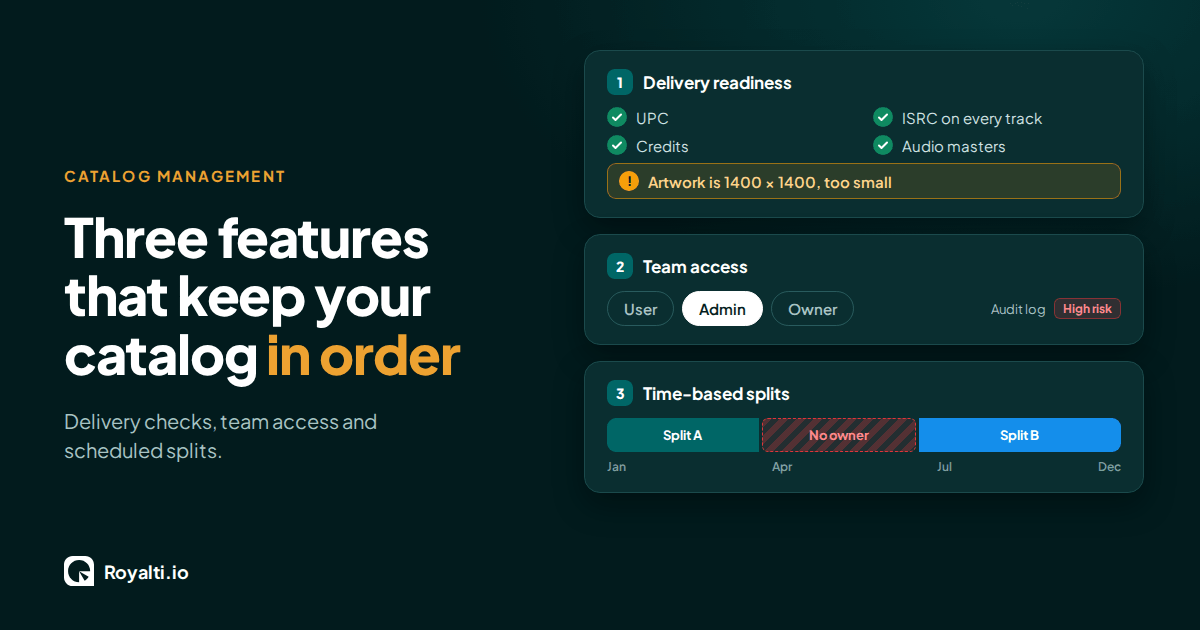
Royalti.io: Three Features That Keep Your Catalog in Order
Delivery checks that stop bad releases, team access you can trust, and splits that change on schedule. Here is how each one works in Royalti.io
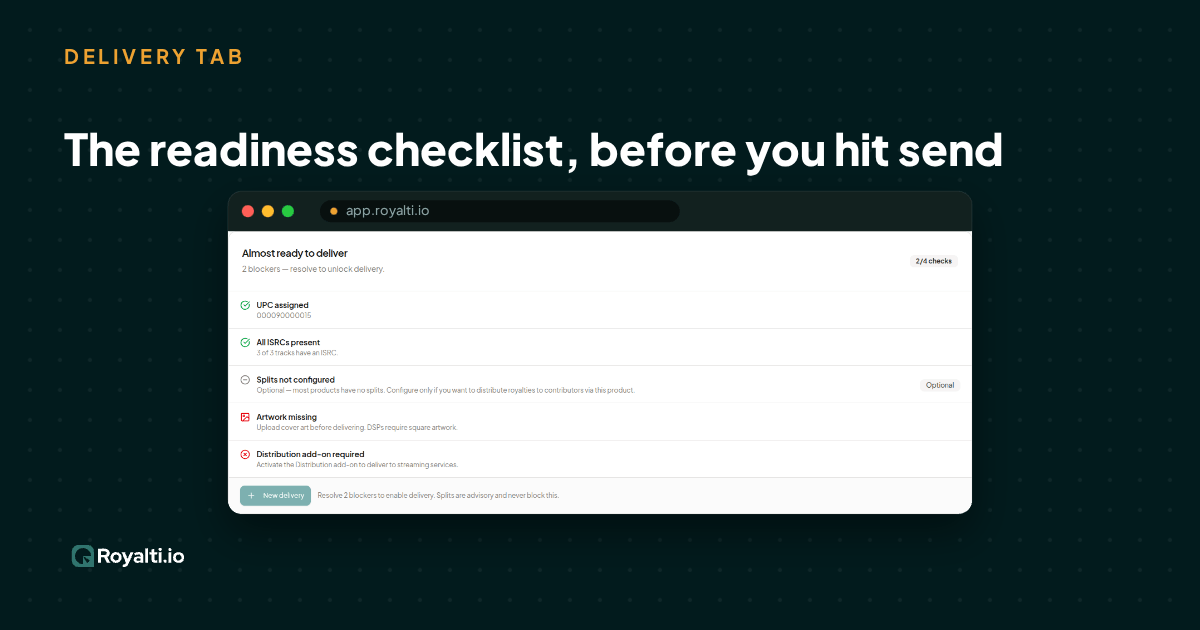
Royalti.io: How We Rebuilt DDEX Delivery
A release can fail on its way to stores without anyone noticing. Here is what broke in our DDEX delivery, how we fixed it, and what you can check first.
AI and Creator Consent 1: What Creator Groups Want From AI Music Deals
Learn why creator groups are demanding consent, fair compensation and transparency from AI music deals
Comments
No comments yet. Be the first to comment!