Time-Based Splits: How to Schedule Ownership Changes on Royalti.io
When a split change depends on someone remembering to make it, it gets missed. Royalti.io's time-based splits let contract terms live inside the system that pays out against them
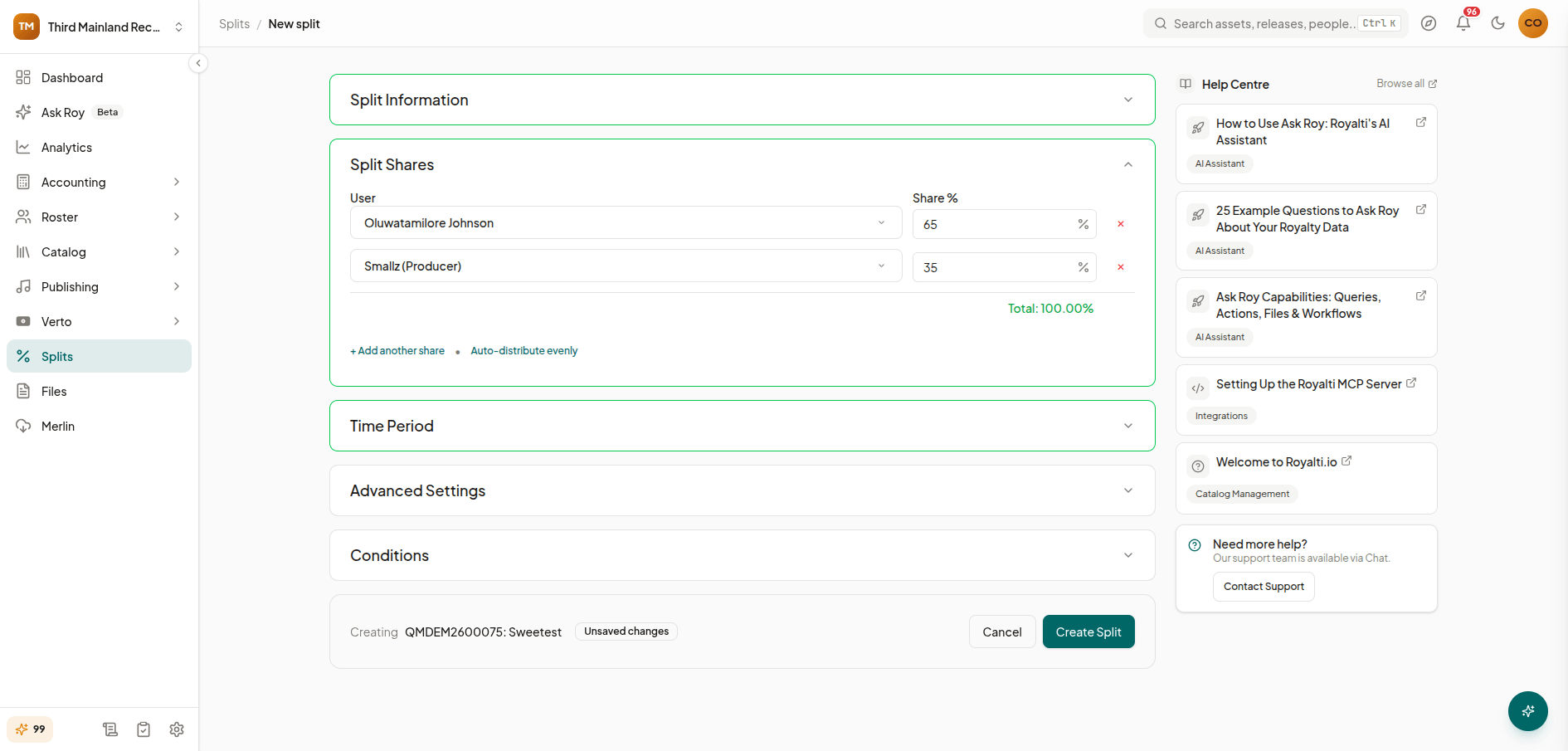
A split sheet records who owns what percentage of a song at a given point in time. The problem is that music ownership can change, and when it does, someone has to remember to update the record. The Royalti.io platform has a feature that reduces that dependency to a single decision, made once.
The truth is, some scenarios warrant changes in music ownership over time. A label's stake in a track will expire the day a licensing deal ends, after which ownership reverts to the artist. A co-writer's share steps up once a song recoups its advance. Whatever the case, it is important that those changes are well documented. That is where the Time-based split feature on Royalti.io comes in.
What Is a Time-based Split
The time-based split is an ownership record with a start date and an end date attached to it, instead of just a percentage. With a time-based split, there is no need to manually edit or rewrite splits every time the deal terms change; you simply define a sequence, and the system enforces the handoff.
For instance, if Split A is set to run from release day until the date the advance is expected to recoup, Split B will take over automatically from that point forward. Split B's start date picks up exactly where Split A's end date leaves off, with no gap or overlap.
When Is This Necessary
There are real situations that have prompted the need for this feature. In each case, the most important question is whether a royalty system can uphold future changes to ownership autonomously. Some of these cases include:
- Recoupment step-ups: A producer or featured artist getting a lower percentage until the advance is recouped, after which they move to their full negotiated share.
- Fixed-term licenses: A distribution deal granting a partner a share of royalties for a set window (perhaps 2 or 5 years), and after which ownership reverts in full to the original rights holder.
- Catalogue succession: An ownership transfer on a known future date, an estate handoff, a buyout closing, or a contract renewal with new terms.
Making Split Changes Auditable
One can ask whether it is necessary to go this far just to effect a split change. The simple answer is yes. Because any system can store a date or record changes to ownership, but the real trick is ensuring that royalty calculations respect those changes consistently.
A change that takes effect on a future date should not silently alter statements already paid out under an old split. Neither should a change entered today apply to periods that came before, distorting historical numbers in the process.
Building splits around explicit start and end dates removes that ambiguity. Rather than just editing a percentage with no date attached, a dated split ensures that the old split governs everything before its end date, while the new split will govern everything from its start date forward.
How Does This Work on the Royalti.io Platform
On the platform, a split record can carry a start date and an end date, and you can schedule a successor split to begin the moment a prior one ends. All you have to do is set it up once, at signing, and the system does the rest, ensuring ownership changes take effect on schedule, without requiring you to check back on the day those changes are due.
As of today, scheduling a future split change is something you set up deliberately. You choose the date, and the date-based split does the rest, but only that. The system will not watch your advance ledger and flip the split automatically the moment recoupment happens.
The Takeaway
What this feature seeks to enforce is nothing new. Contracts already describe ownership changes with dates, in terms like: "until recoupment", "for a term of 24 months", or "reverting on expiry." With time-based splits, those contract terms live inside the system that pays out against them, so the ownership change happens on schedule instead of whenever someone remembers to make it happen.
Yes, most releases do not need any of this; a large share of tracks have a single rights holder and do not require any scheduling at all. But this feature exists for the releases where ownership is anticipated to change over time. And that is why splits are opt-in on the platform, so that when you need it, it is there.
About the author
Keep reading
All posts →AI and Creator Consent 2: Before You Opt In to an AI Music Deal
Your distributor or publisher may already have the right to license your music for AI use. Here is what to ask and what to check for before you say yes.
AI and Creator Consent 1: What Creator Groups Want From AI Music Deals
Learn why creator groups are demanding consent, fair compensation and transparency from AI music deals
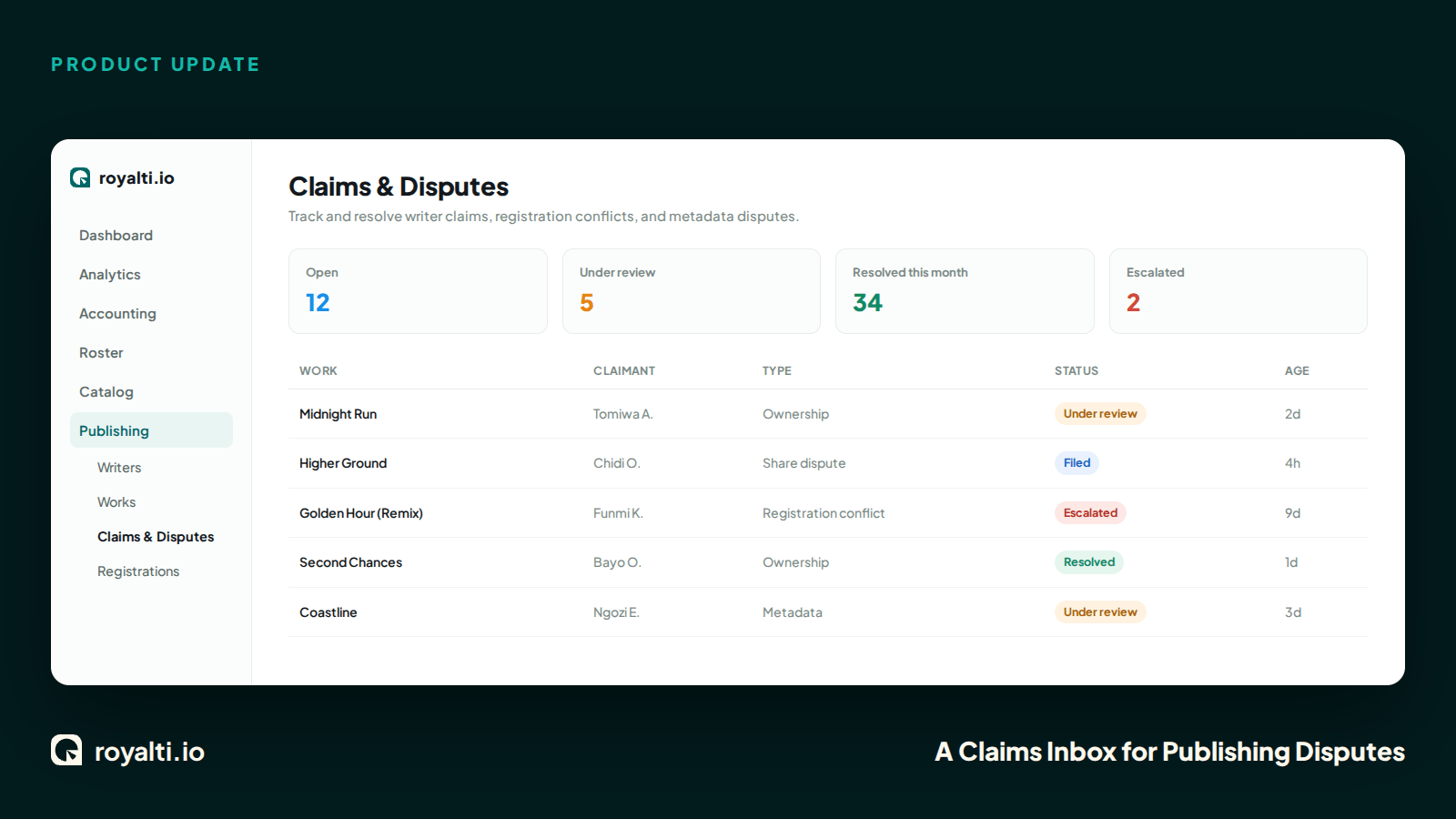
Did You Know: Royalti.io Has a Claims Inbox for Publishing Disputes
Royalti.io built a structured workflow for ownership and registration conflicts, so disputes have a start, a middle, and an end that is provable after the fact
Comments
No comments yet. Be the first to comment!