Did You Know: Royalti.io Has a Claims Inbox for Publishing Disputes
Royalti.io built a structured workflow for ownership and registration conflicts, so disputes have a start, a middle, and an end that is provable after the fact
The ultimate test of a good platform has little to do with how well it performs now, and more with how well it withstands the test of time. I know it sounds a bit cliché, but hear me out. A good service knows to evolve and expand alongside the solution it offers, anticipating hiccups and resolving them before they grow into a real pain.
So why am I saying this? Recently, we built a structured workflow for ownership and registration conflicts. We deemed it expedient to create a way to efficiently resolve them rather than letting them get routed through emails. Now the question is, why did we do that?
First, We Saw the problem
When a co-writer disputes their split or a collection society flags two registrations for the same work under different splits, it is someone’s job to track down every party, collect evidence of who wrote what, negotiate a number everyone can live with, and then remember to actually update the work record once it is settled. If that sounds like a lot of back and forth via email, it is. Resolving a writer-share dispute is very delicate work.
And the problem is that keeping an accurate record of that resolution can also be intricate because none of that communication lives anywhere. The thread gets buried in an inbox somewhere, with the evidence as an attachment that nobody can find six months later. The only record that a dispute happened or that it was even resolved would be whatever the admin remembers to type into a spreadsheet. So imagine when a PRO or a sub-publisher asks for proof of resolution, and there isn't one.
What We Came Up With
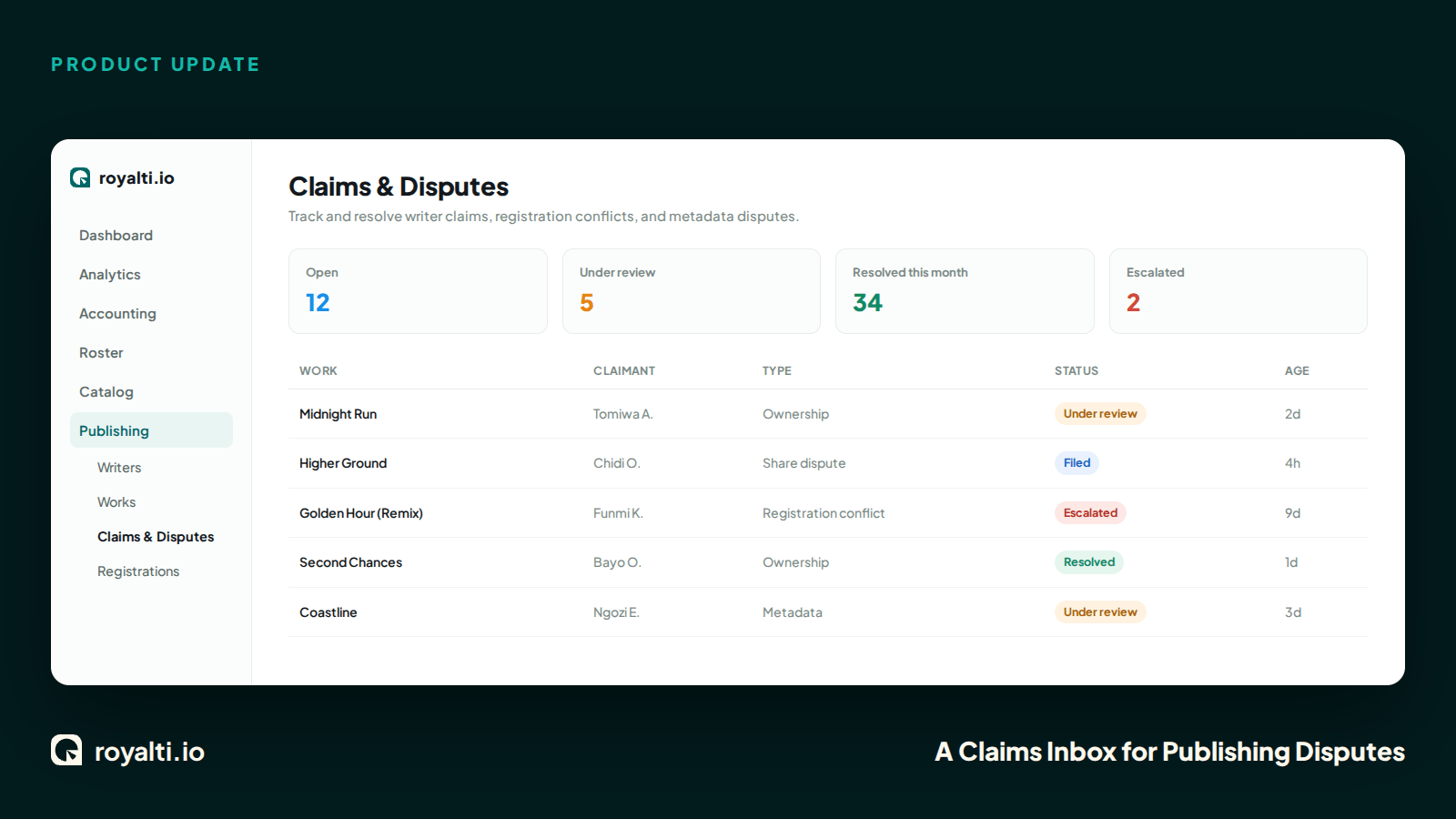
And that is the gap the claims inbox was built to close. A structured place for a dispute to live from the moment it is filed to the moment it is resolved, and the best part is an in-built audit trail that automatically builds a proof of resolution.
Where Is It?
The claims inbox lives inside Royalti.io's publisher add-on, alongside work registration, writer management, and CWR export. It is built to work with the registration-conflict data that already comes out of the publishing pipeline. So if your catalog has open disputes sitting in an inbox right now, that is exactly the kind of backlog this is meant to absorb.
How Does It Work?
All it takes is for a writer or admin with visibility into a work to file a claim. It could be an ownership claim, a share dispute, a registration conflict, or a metadata correction. Once filed, the claim moves through defined stages: filed, under review, resolved, escalated, or withdrawn.
A dispute can also birth a counter-claim, so that the other side of an argument has a formal place to state its case as well.
Every claim carries its own conversation with evidence attachments, allowing parties to add documents, audio, or contracts directly to the claim and discuss it in a threaded message log. These discussions are visible to the people involved, and every status change is recorded automatically as a system message in that same thread. The history of the dispute is the thread itself, not separate email chains or a record reconstructed by an admin after the fact.
How Well Does It Scale?
For teams handling volume, say a label with dozens of open conflicts after a catalog import, for instance, claims can be filtered by status, society, or work, and resolved in bulk with a single reason applied across the batch. Everyone with a stake in a claim gets notified the moment its status changes: a new claim filed, a counter-claim raised, a status update, or a new message.
Why Was This Even Worth Building?
First of all, let us be clear about one thing. Nothing beats a good contract or clean splits at the point of registration. The best dispute will always be the one that never gets filed.
However, registration conflicts are inevitable, especially with collaborative work. Catalogs get inherited, contributors get miscredited, or two societies register the same work with different numbers. These are conflicts that can block a work from registering cleanly with a PRO, delay royalties from flowing to the right writer, or resurface unexpectedly months later as a repeat dispute. The claims inbox literally turns that into a process with a start, a middle, and an end. A process that is now provable after the fact, with a record of how it was sorted.
The feature also changes who can actively participate in these resolutions. A co-writer does not need admin access to file a claim, attach their evidence, and follow it through.
About the author
Keep reading
All posts →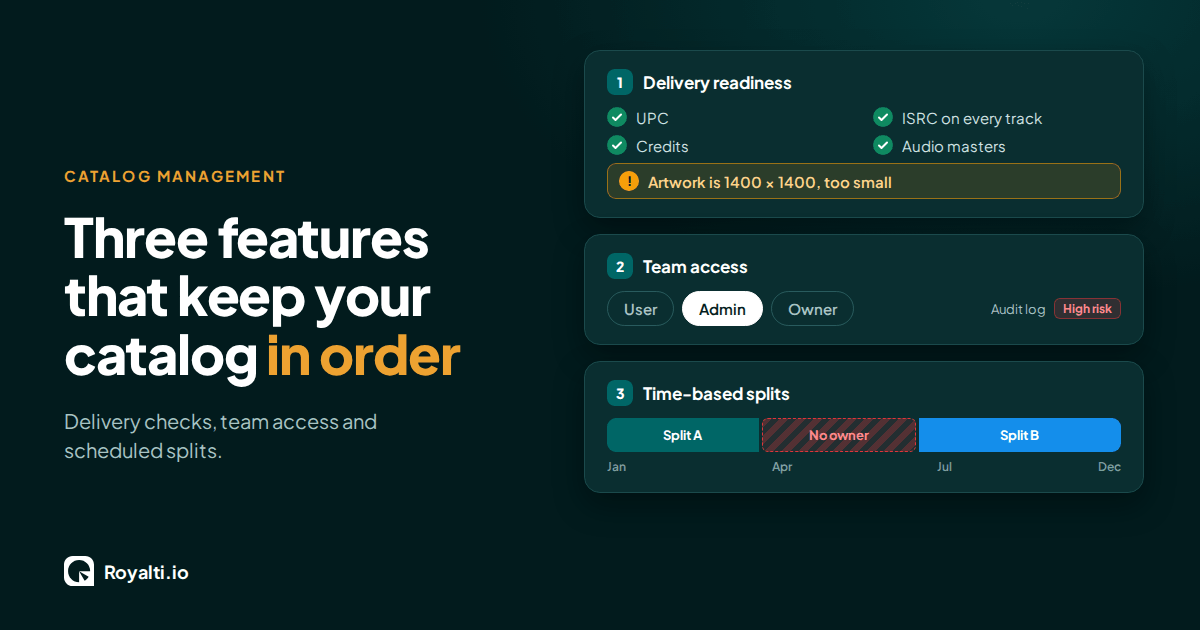
Royalti.io: Three Features That Keep Your Catalog in Order
Delivery checks that stop bad releases, team access you can trust, and splits that change on schedule. Here is how each one works in Royalti.io
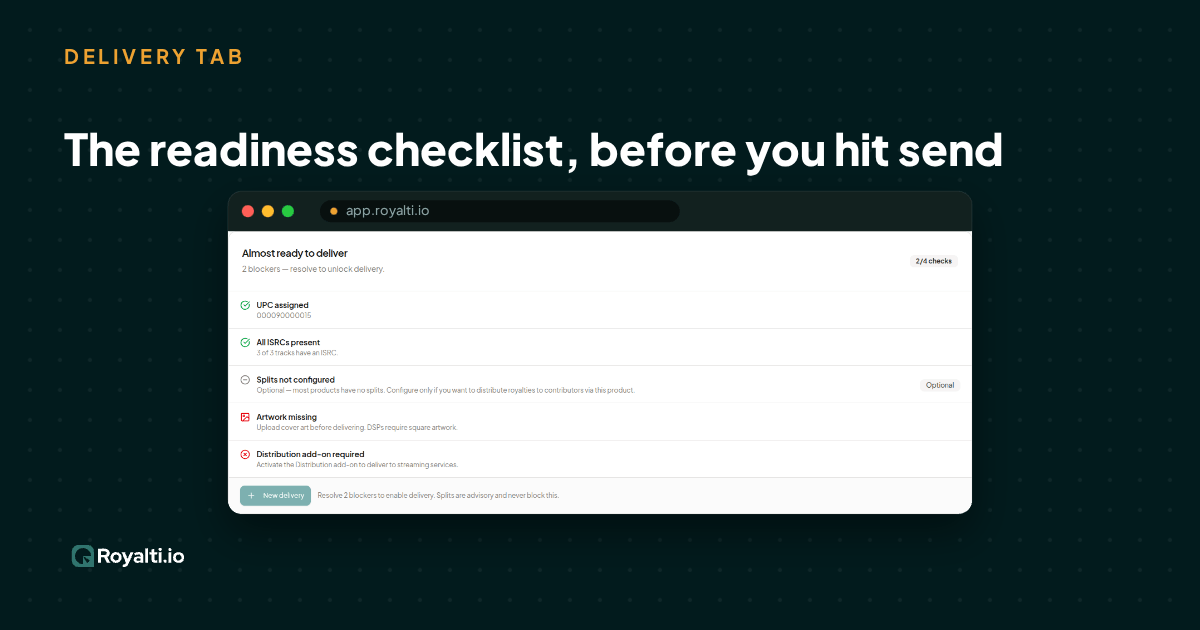
Royalti.io: How We Rebuilt DDEX Delivery
A release can fail on its way to stores without anyone noticing. Here is what broke in our DDEX delivery, how we fixed it, and what you can check first.
AI and Creator Consent 2: Before You Opt In to an AI Music Deal
Your distributor or publisher may already have the right to license your music for AI use. Here is what to ask and what to check for before you say yes.
Comments
No comments yet. Be the first to comment!