7 Essential Royalty Period Terms Every Artist Must Know (Part 1)
📚 This is Part 1 of a 2-part series
- Part 1: Essential Period Terms (you are here)
- Part 2: From Stream to Payment - The Complete Journey
Royalty statements can feel like they were written in another language, yet these labels are the foundation of how your royalties are tracked, calculated, and paid. This first part of our two-part series breaks down the essential period-related terms you'll see on your royalty statements and explains how each one fits into the royalty process.
A Guide to Understanding Your Statements
Ever wondered what certain terms in your royalty statements actually mean? You open your first statement and suddenly you're faced with terms like "Accounting period ending Q2 2024," "Sales period January-March 2024," and "Grace period: 90 days." You know they are English words, but you can neither make heads nor tails of what all these different periods mean.
Believe it or not, you are not alone. Many artists struggle not only with the long wait for payments but also with the confusing period-related terminology used in royalty statements. Additionally, the same data can appear across multiple statements with different period labels.
However, with a little help from us, you will be able to read your next royalty statements with confidence. By the end, you will understand every period-related term, what it means, and how each one fits with the others.
First Things First: What Are Royalty Periods?
A royalty statement is simply data arranged across multiple timelines. Each timeline or period represents a different stage in tracking your music, how it is consumed, reported, calculated, and royalties paid out.
For example, when someone streams your song on Spotify, that usage data does not instantly arrive at your distributor (like DistroKid or Africori). Instead, Spotify collects the data for a month, reports it in the following month, your distributor processes it afterwards, and then it shows up on your statement.
Understanding these timelines explains how each period serves a different purpose and why statements look the way they do.
Why Royalty Periods Matter
As we mentioned earlier, every stage of your royalty journey has a period attached to it:
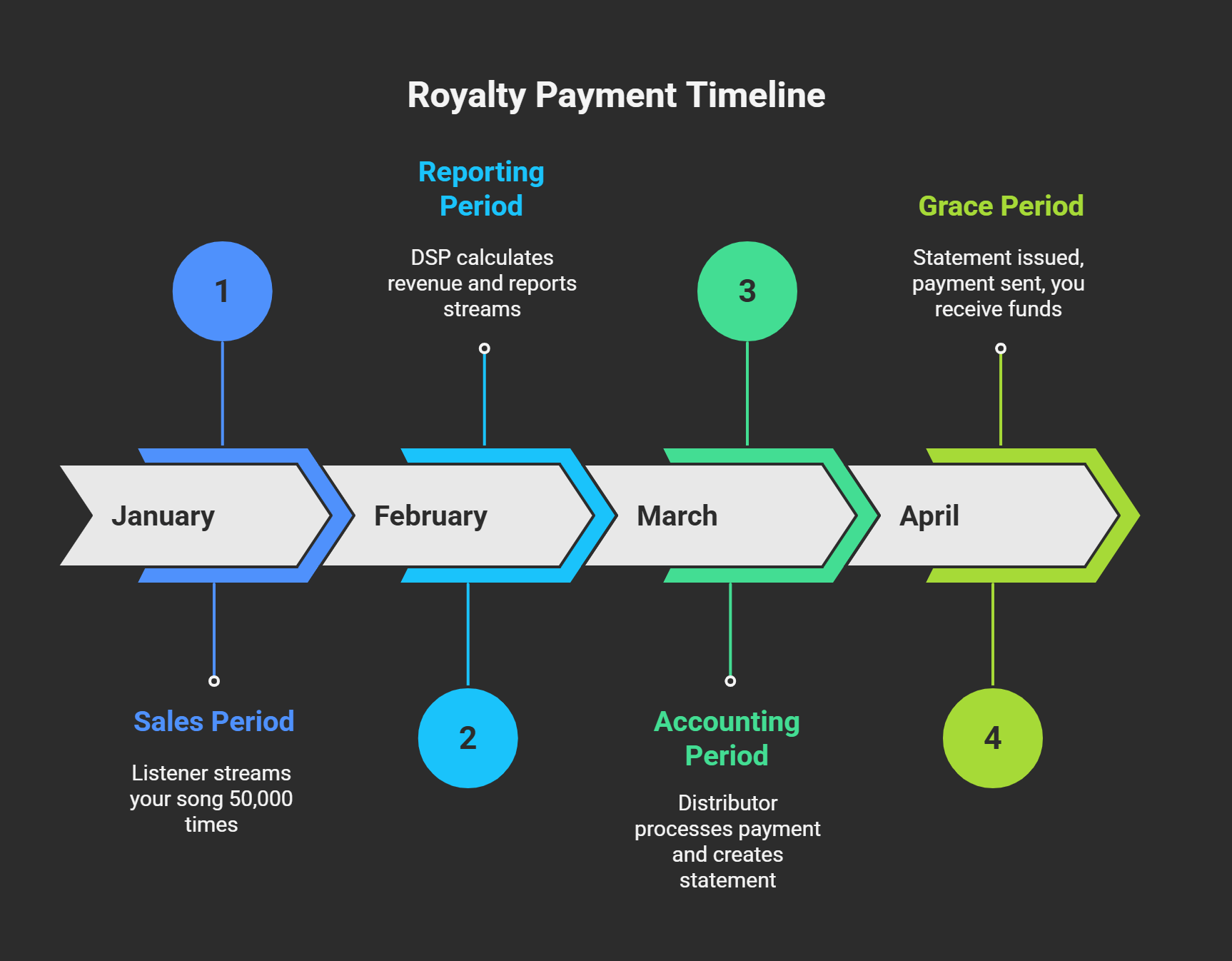
- When the music was actually streamed or downloaded: Sales period
- When the royalty data was reported: Reporting period
- When the royalty statement was finalized and issued: Accounting period
- When the royalty statement covers: Statement period
Without understanding each of these terms, a royalty statement becomes a confusing document where the same usage data appears multiple times under different headers.
Now, let's break down what each period term means.
7 Essential Royalty Period Terms
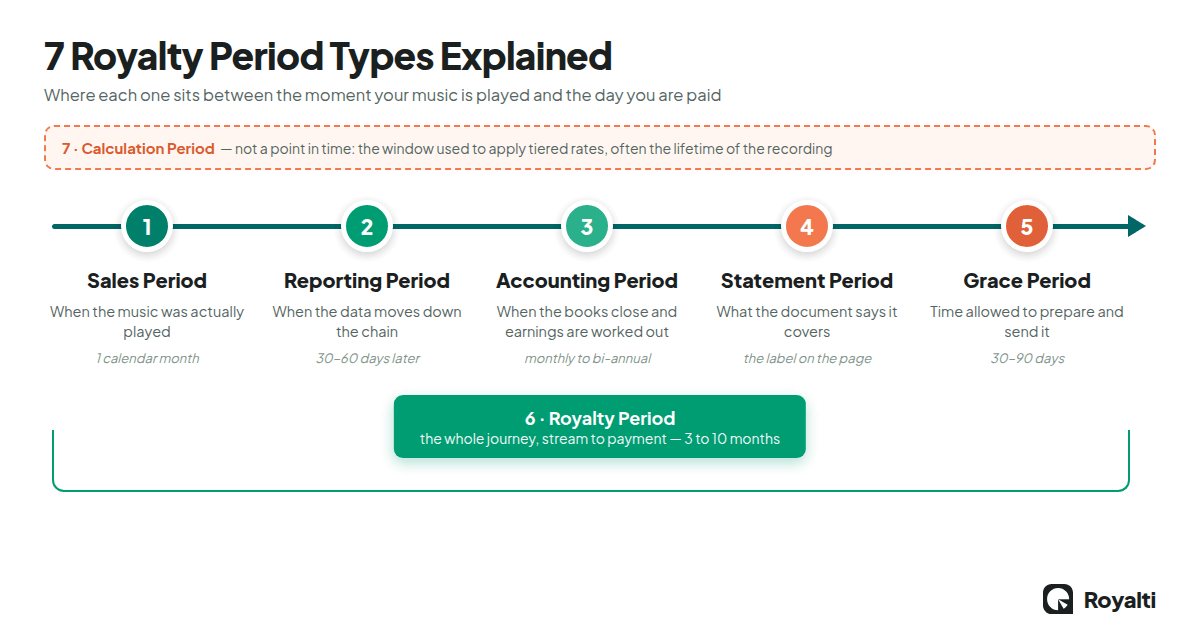
1. Sales Period
Also called the Usage Period or Consumption Period, it refers to the actual time frame when your music was streamed, downloaded, broadcast, or synced in a film.
Why it matters: The sales period represents when listeners engaged with your music. It is typically organized by calendar months so when you see "Sales Period: January 2024", it means all consumption between January 1-31, 2024.
Example: Your song gets 100,000 Spotify streams in January 2024 (that's your sales period). But Spotify won't report these streams to your distributor until the end of February 2024. You won't see the data on your statement until March or April. The stream happened in January, but you see it three months later.
2. Reporting Period
This is when usage data is collected and reported from one party to the next. We have already established that data doesn't flow instantly through the royalty chain. Each platform and institution operates on its own reporting schedule:
- DSPs → Distributors: 30-60 days after the sales period ends
- Distributors → Artists: Monthly (modern standard as of 2025)
- Labels → Artists: Bi-annually or quarterly (traditional), monthly (progressive indie labels)
- PROs → Members: Quarterly (some monthly for streaming)
Why it matters: The reporting period explains the lag between when music was consumed and when you see the data.
Your March 2025 statement might include:
- Apple Music streams from January 2025 (they reported on time)
- Spotify streams from December 2024 (late reporting)
- Boomplay revenue from March 2023 (very late reporting)
Same statement, different reporting periods. The Reporting Period is not always listed in reports and statements. It may also be referred to by a different term.
3. Accounting Period
This is the timeframe during which a royalty statement is prepared and finalized. This is when a distributor, label, or publisher closes its books and calculates earnings.
Typical accounting periods:
- Bi-annual (Semi-annual): H1 (January-June), H2 (July-December) - traditional major labels
- Quarterly: Q1 (Jan-Mar), Q2 (Apr-Jun), Q3 (Jul-Sep), Q4 (Oct-Dec) - modern standard
- Monthly: By calendar months; distributors and progressive labels
Why it matters: A statement labeled "Accounting Period: Q2 2024" doesn't mean all the music in it was streamed in Q2. It means calculations were finalized in Q2. Depending on which platforms reported late, a statement labeled "Accounting Period: H2 2024" (July-December) might actually include sales data from May, June, July, August, September, or October.
What to look for in contracts:
Terms like:
"Royalties shall be calculated and paid within ninety (90) days following the close of each semi-annual accounting period,"
This line tells you the accounting period (semi-annual) and the grace period (90 days). If H1 closes June 30, statement calculations are finalized by September 30.
4. Statement Period
This is the date range covered by the royalty statement. The statement document carries a date marker that shows which accounting period it is for.
Why it matters: The statement period is the label on the document, not necessarily the label on the data inside it. Royalty software companies recommend organizing statements by payment received date rather than statement date.
The statement header might say "Statement Period: March 2025," but may include sales data from December, January, and February: same statement period label, three different sales periods of actual data.
Best practice:
Don't rely on the statement header. Look inside the statement to find the actual sales period dates.
5. Grace Period
This is also called the Statement Preparation Period, and it is the time allowed after an accounting period ends for the label, publisher, or distributor to finalize and deliver your statement.
During the grace period, the accounting team:
- Reconcile late reports from platforms
- Calculate deductions and recoupment
- Finalize splits between multiple parties
- Generate and format the statement document
Why it matters: After the accounting period ends, the grace period indicates how long you should expect to see the statement. Think of this as the administrative buffer. It is a contractual deadline, not the actual data deadline.
Typical grace periods by entity:
- Major labels: 90 days
- Independent labels: 60-90 days
- Distributors: 30-45 days
- Publishers: 60-90 days
Example: Your distributor closes their Q1 accounting period on March 31. Your contract specifies a 45-day grace period. That means you should see your statement by May 15.
Red flags that may indicate cash flow or management problems:
- Grace periods longer than 90 days (without clear justification)
- Statements consistently arriving after the grace period ends
- No grace period defined in your contract
6. Royalty Period
This is the Payment Period and marks the full journey from music consumption to royalty payment, and encompasses all the other periods combined.
And depending on the mode of music consumption or the distributor's model, the royalty period can vary. Let's compare three common scenarios:
Direct Digital Distribution (Fastest): 3-4 months total
- Month 1: Streams occur (sales period)
- Month 2: DSP reports → distributor (reporting period)
- Month 3: Distributor processes and creates a statement (accounting period)
- Month 4: Payment arrives
Traditional Label Deal (Slower): 9-10 months total
- Month 1: Streams occur
- Month 2: DSP reports to label's distributor
- Months 3-6: Accounting period continues (H1 still open)
- Months 7-9: Grace period (statement preparation)
- Month 10: Payment arrives
Performance Royalties via PRO (Slowest): 9-12 months total
- Month 1: Radio play or stream occurs
- Months 2-4: Venue/broadcaster reports to PRO
- Months 5-8: PRO processes and matches data
- Month 9: Statement issued
- Month 10: Payment arrives
Why it matters:
Now you can see why the same stream appears on multiple statements, it is not an error; it is different royalty types being paid at different times.
7. Calculation Period
This is the timeframe used to calculate variable royalties, often tied to performance thresholds or escalating rates.
This term is particularly important when you have tiered royalty structures. For example, Artist shall receive:
- 12% for the first 100,000 units
- 14% for 100,001 to 500,000
- 16% after 500,000
The calculation period for reaching that threshold may depend on several factors. It could be:
- Per release?
- Per year?
- Lifetime of the contract?
Most escalating royalty contracts use "lifetime of the recording" as the calculation period. This means once an artist hits 100,000 total streams (cumulative since release), their rate increases for all future earnings.
Why it matters: Understanding the calculation period helps you determine which earnings are subject to which royalty rate, even if you still receive monthly or quarterly statements.
How These 7 Periods Work Together
Red Flags: Watch for These Warning Signs
When reviewing your contracts, watch for these red flags that may indicate cash flow or management problems:
- Grace periods longer than 90 days (without clear justification)
- Statements consistently arriving after the grace period ends
- No grace period defined in your contract
- Vague language about when statements will be issued
✅ You Now Understand the 7 Essential Royalty Period Terms!
You've learned:
- Sales Period - When music was consumed
- Reporting Period - When data moved through the chain
- Accounting Period - When statements were finalized
- Statement Period - What the document covers
- Grace Period - How long until you see the statement
- Royalty Period - Full journey from stream to payment
- Calculation Period - When rate changes apply
Ready to see how these periods work together in practice?
In Part 2, we'll walk you through:
- The complete timeline from a single stream to your payment
- How these periods interact across multiple platforms
- Best practices for reading your statements
- Questions to ask your distributor or label
→ Continue to Part 2: From Stream to Payment - The Complete Journey
About Royalti.io
Royalti.io automatically organizes your royalty data by Accounting Period and Sales Period, giving you a clear, accurate picture of your earnings with minimal effort. Learn more →
Further reading
- PRS for Music announces monthly royalty payments for online streaming - PRS for Music, 2025
- Understanding Spotify Royalties - Spotify for Artists, accessed October 25, 2025
- How and When Do I Get Paid? - DistroKid Help Center, accessed October 25, 2025
- When do I get paid? - TuneCore Support, accessed October 25, 2025
- ASCAP Distribution Schedule - ASCAP, accessed October 25, 2025
- How often should I pay royalties? - Curve Royalty Systems, accessed October 25, 2025
- Royalty Accounting Sample Clauses - Law Insider, accessed October 25, 2025
All sources accessed and verified on October 25, 2025.
Keep reading
All posts →
Royalti.io: How We Rebuilt DDEX Delivery
A release can fail on its way to stores without anyone noticing. Here is what broke in our DDEX delivery, how we fixed it, and what you can check first.
AI and Creator Consent 1: What Creator Groups Want From AI Music Deals
Learn why creator groups are demanding consent, fair compensation and transparency from AI music deals
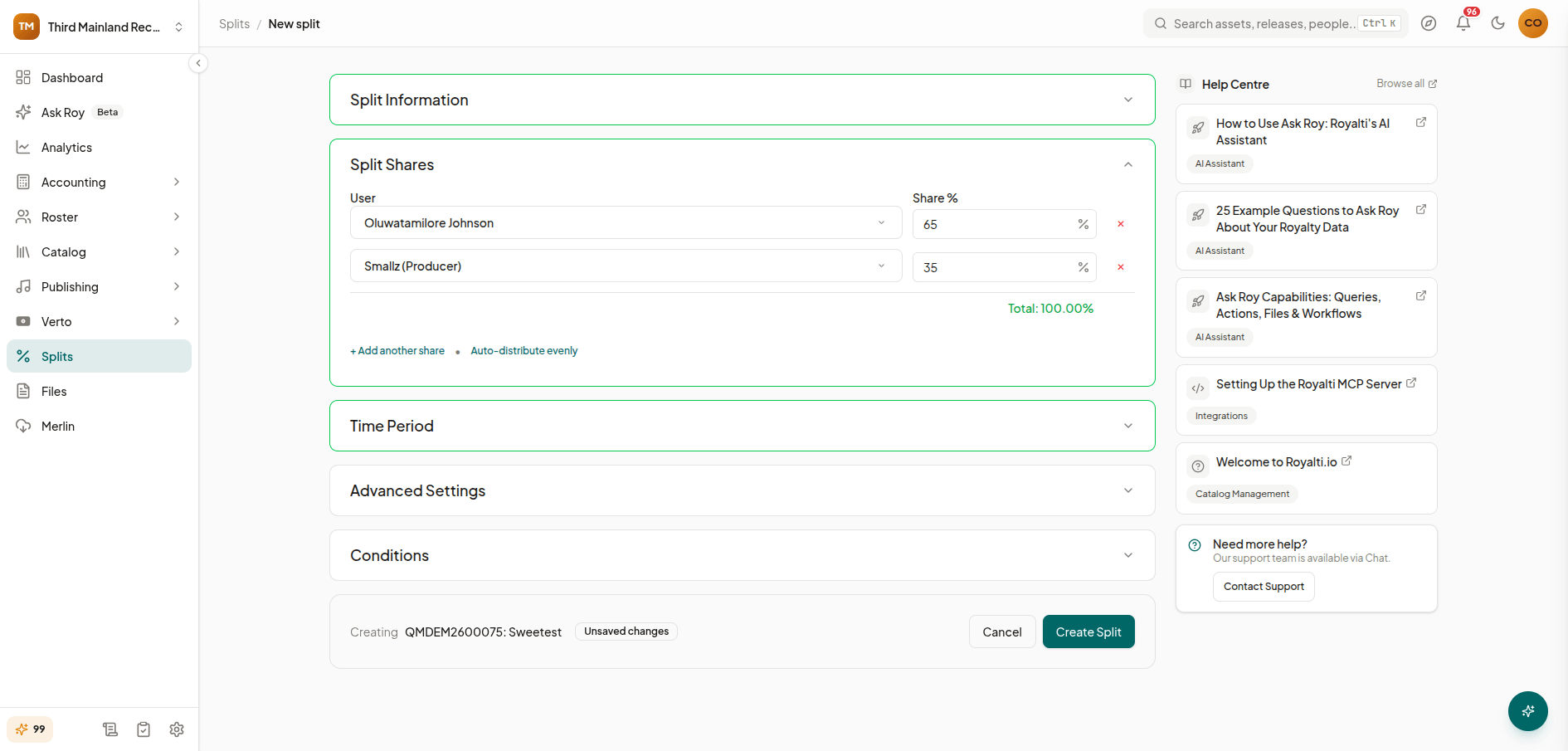
Time-Based Splits: How to Schedule Ownership Changes on Royalti.io
When a split change depends on someone remembering to make it, it gets missed. Royalti.io's time-based splits let contract terms live inside the system that pays out against them
Comments
No comments yet. Be the first to comment!