Decoding Your Streaming Statements: A 2025 Guide to Per-Stream Rates & Splits
Confused by streaming payouts? Our 2025 guide breaks down per-stream rates, DSP splits, and how to maximize your music royalties.
Do you even know how your royalty earnings are calculated? Abi, “I should mind my business”? That amount that hits your account every month, or at the end of every quarter, depending on your distribution agreement, do you actually know how that figure was determined?
Look, we have said it time and again: music is business. It is not enough to be talented: sing your heart out, upload your song to a digital platform, and call it a day. No. You must be as committed to the business side of music as you are to honing your craft. You literally cannot afford to be ignorant.
How Payouts Are Calculated
Although it may feel like a guessing game, there is a structure to how streaming platforms pay creators (well, kinda). First of all, several factors influence how much you get paid as a creator, starting with the payment model adopted by the platform in question. Then, there are other elements, such as where your listeners are located.
Believe it or not, where your fans stream from significantly affects how much money you get paid per stream. (I wrote a previous post explaining this in detail, so please do well to read it.)
But, before we get ahead of ourselves, let’s look at the main payment models used by streaming platforms.
Streaming Platforms’ Payment Models
The Pro-Rata Model
This is the most common approach, used by music streaming platforms such as Spotify and Apple Music. All money generated through subscription and advertising in a country goes into one pool. From this pool, the platform takes a percentage and distributes what is left to rights holders based on their share of the total streams.
However, a single stream’s value varies by the country of the listening audience, and the system is designed to favor the heavy lifters (artists with a higher number of streams). With a large percentage of the overall revenue pool tending to go to the top artists, even when those make up just a small number of overall creators.
The User-Centric Model
This model directs a user’s subscription fee to be distributed only to the artists that they listened to. This model is adopted by platforms such as SoundCloud and Tidal, and is a “fan-powered royalty system” where engagement, not just numbers, matters. So, even for smaller artists, priority is placed on listener loyalty and activity.
The Artist-Centric Model
Introduced by platforms like Deezer, this model is a hybrid version of the pro-rata model.
The way it works is:
- Streams from fans who actively search for an artist are valued more than algorithmic plays.
- Artists who cross a set threshold of monthly streams get a multiplier, boosting their per-stream rate.
While still utilizing pro-rata characteristics such as the revenue pool, this model aims to reward artists who have a dedicated following within a specific region.
Direct-to-Fan/Digital Retail Model
Though this is not a streaming revenue model, it is worth noting. Here, artists sell their music and merchandise directly to fans. The platform takes a small commission while the artists keep most of the revenue. The model offers a lucrative way for artists to earn on a per-transaction basis, while strengthening the relationship between the artists and their fans.
Factors That Affect Your Payouts
Several factors influence your final per-stream rate and how much money you actually receive:
Territory
As mentioned earlier, the geographical location of the listeners matters. Payouts vary widely by region. A stream from a country with higher subscription rates is worth more than one from a market with lower rates.
Free vs. Paid Streams
Streams from premium subscribers are worth much more than those from free, ad-supported users.
DSP Split
The rate each streaming service sets as its commission, plus their payout rate may also vary by platform. For example, Spotify pays roughly $0.003–$0.005 per stream, while Apple Music averages $0.01–$0.0125.
Distributor Fees
Distributors also take their share. While some charge a flat fee and let you keep all your royalties, others take a percentage of your earnings. Add to this any label or producer agreements, and your net payout may look very different from the gross.
Conclusion
The models might be different, but the maths is the same: your payout equals rate per stream multiplied by the number of streams. Streaming is ultimately a numbers game, accounting for most of today’s music industry revenue. In 2025, the focus should not just be on increasing streaming numbers, but on better engagement.
That’s why many artists now spread their music across multiple platforms, maximize visibility, and tap into social media and viral trends. Fan-driven engagement has become central to marketing, publicity, and even how songs are released.
Still, streaming is just one piece of the puzzle. Tours, merchandise, licensing deals, and direct-to-fan sales remain income streams that, when combined with streaming, create a sustainable music career.
If you would like to know more about Spotify’s royalty payout model, check out my earlier post.
Don’t forget that, whatever platform you choose to use, Royalti.io helps you make sense of your royalty data, so you spend less time buried in spreadsheets and more time making music.
About the author
Keep reading
All posts →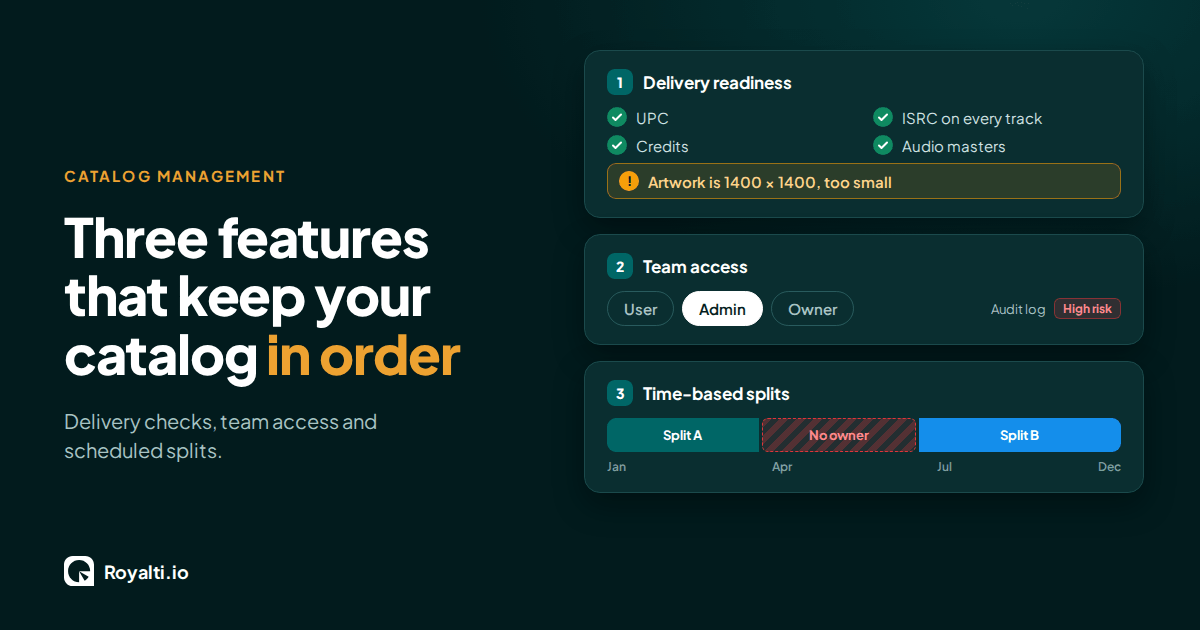
Royalti.io: Three Features That Keep Your Catalog in Order
Delivery checks that stop bad releases, team access you can trust, and splits that change on schedule. Here is how each one works in Royalti.io
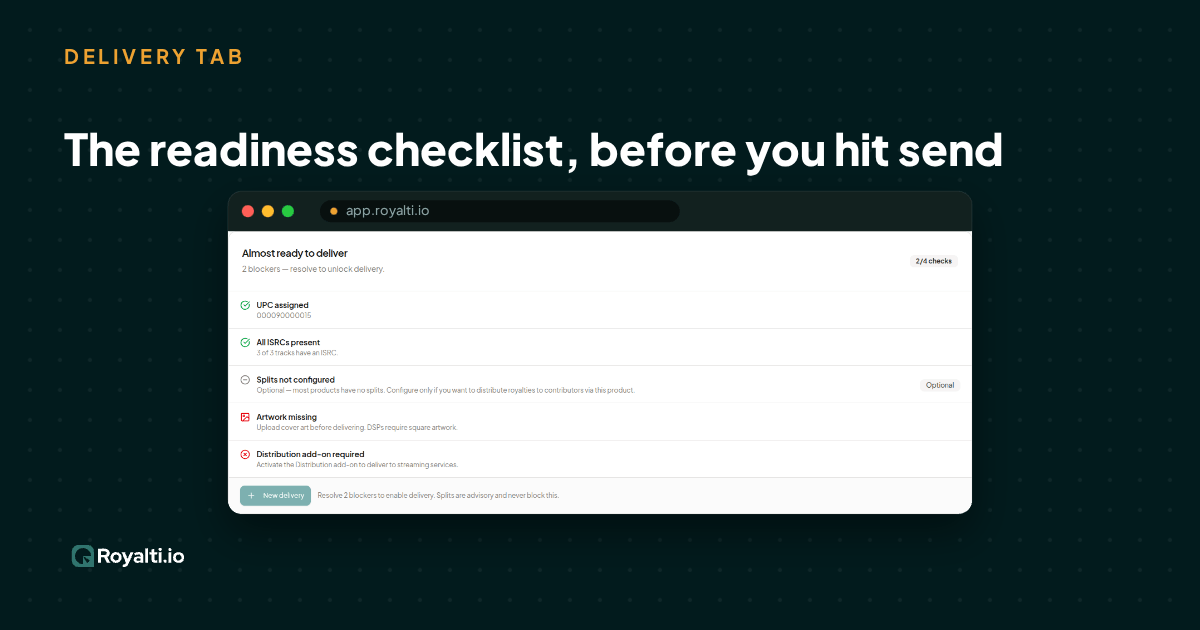
Royalti.io: How We Rebuilt DDEX Delivery
A release can fail on its way to stores without anyone noticing. Here is what broke in our DDEX delivery, how we fixed it, and what you can check first.
AI and Creator Consent 1: What Creator Groups Want From AI Music Deals
Learn why creator groups are demanding consent, fair compensation and transparency from AI music deals
Comments
No comments yet. Be the first to comment!