5 Ways AI Is Used In Music Royalties, Rights Management, and Reporting
Here are five AI tools working behind the scenes to automate royalties, detect fraud, and recover earnings for artists.

Even as we debate whether the injection of Artificial intelligence into creative spaces is a riveting innovation of the modern age or the beginning of the end of human creativity, it is still in our collective interest to keep track. In the music industry particularly, AI has come a long way, beyond the production of the music itself; music tech has deployed this technology to automate and streamline processes in ways that are as practical as they are fascinating.
5 Things AI Can Do In Music Right Now
1. The Royalti.io MCP
The Model Context Protocol (MCP) of the Royalti.io platform turns an AI assistant like Claude into a direct operator of your royalty platform. Its versatility is evident in what it makes possible: multiple external assistants can securely access music data, from uploading statements to querying earnings, generating DDEX packages, and running multi-step analysis, all of which are simplified to plain English commands. Instead of manually uploading CSVs, professionals can use one central AI to fetch live earnings, generate DDEX packages, and automate workflows across multiple platforms instantly.
2. Royalti.io’s AI Assistant, Roy
Roy is Royalti.io’s very own in-house AI assistant, embedded within its dashboard and equipped with 126 purpose-built tools. This AI assistant is designed specifically for the royalty management workspace. Roy automates workflows with a focus on ensuring efficiency and accuracy in royalty data management. Tasks such as auditing catalogs for missing splits, detecting revenue anomalies, and processing distributor files are handled by transforming complex spreadsheets into conversational data. Roy is not just answering questions, but doing operational work, eliminating hours of manual processing at the same time.
3. Spotify's AI Spam Filter
Spotify now requires the disclosure of AI involvement in song tracks. It does this with the use of DDEX metadata standards, which are a set of XML and JSON-based messaging formats designed to standardize how music data is exchanged, thus improving both distribution and royalty reporting. Three things to note with this new development are:
- Spotify requires labels and distributors to disclose the extent of use of AI in a track. Whether it was AI-assisted mastering, instrumentation, or synthetic vocals, creators must accurately tag their work.
- Spotify has strengthened its anti-impersonation policies, specifically targeting unauthorized voice clones and deep fakes.
- It has introduced an AI-driven spam filter that detects manipulative patterns such as artificially short tracks, duplicates, and mass uploads, and will automatically de-rank them, which basically removes them from recommendations.
4. Muserk's Blue Matter AI
While Spotify’s approach is focused on protecting the royalty pool from being diluted going forward, a Nashville-based rights management company called Muserk uses its AI system to recover royalties that were lost across multiple platforms. The system known as Blue Matter performs metadata cleaning and content matching, specifically identifying "unclaimed" royalties sitting dormant across streaming platforms such as YouTube and Spotify. The system prides itself on recovering income already earned, but that got swallowed somewhere in the system, fixing fragmented data and reconciling artists and publishers with royalties that are rightfully theirs.
5. Soundhound's ACR (Automatic Content Recognition) Technology
SoundHound's Automatic Content Recognition (ACR) technology detects copyrighted music in user-generated content. The system generates automated reports carrying metadata such as song titles, artist details, timestamps, and ISRC identifiers. As platforms like TikTok and YouTube face growing legal responsibility for user uploads, ACR gives these platforms an accurate picture of what copyrighted music is being used. Helping not only to support royalty reporting but also to reduce legal risk for these platforms.
About the author
Keep reading
All posts →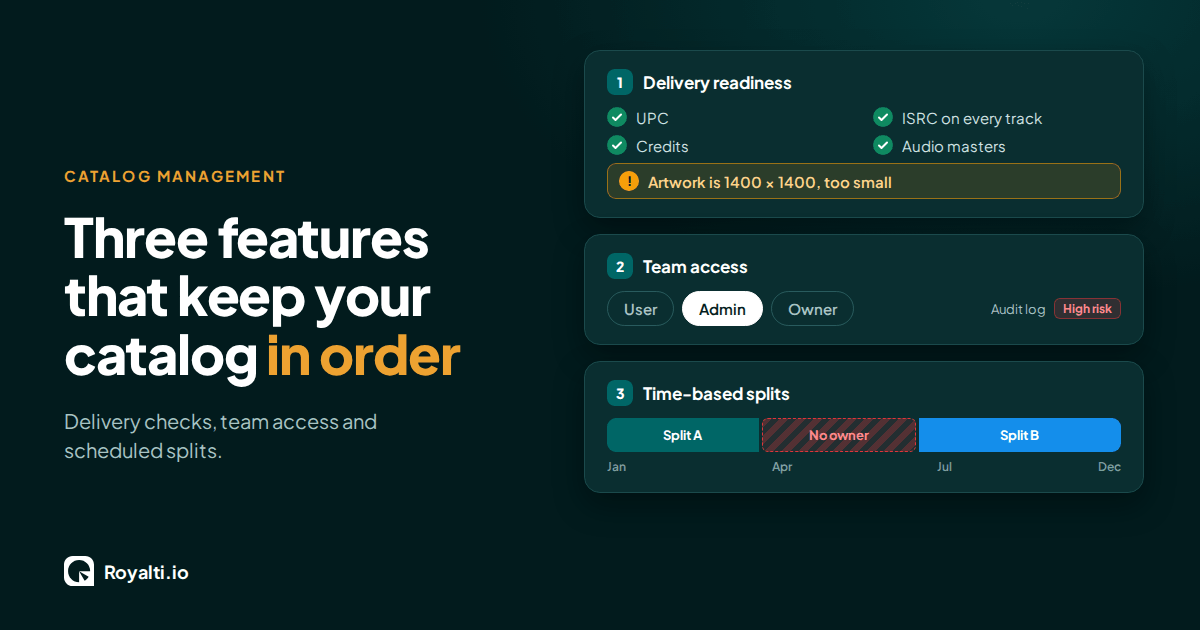
Royalti.io: Three Features That Keep Your Catalog in Order
Delivery checks that stop bad releases, team access you can trust, and splits that change on schedule. Here is how each one works in Royalti.io
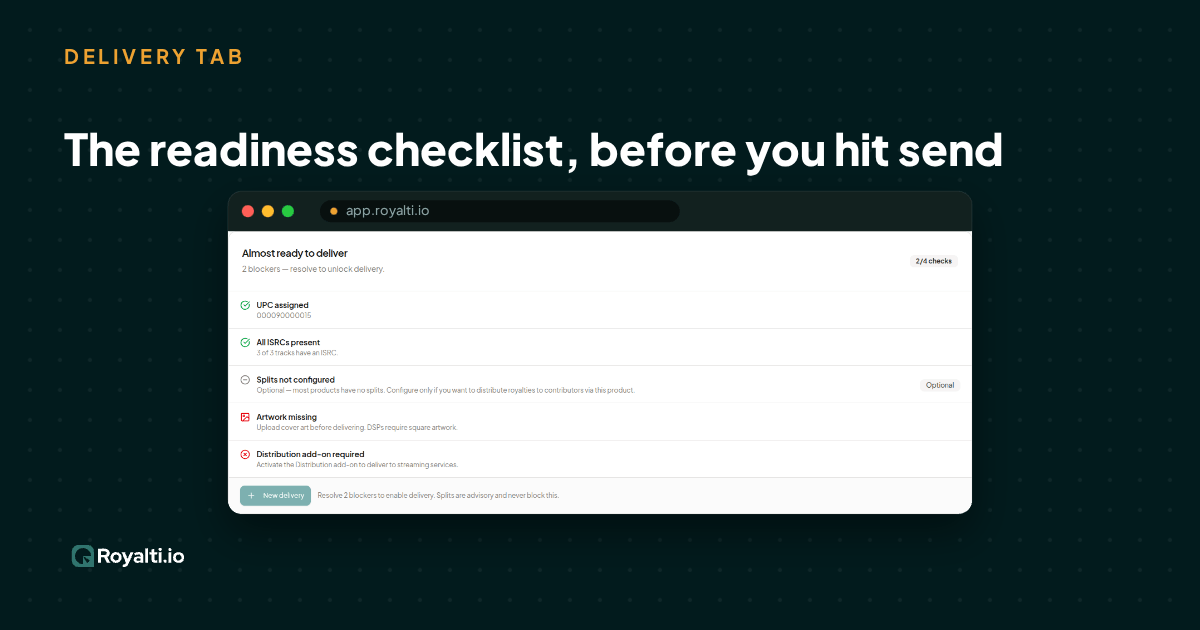
Royalti.io: How We Rebuilt DDEX Delivery
A release can fail on its way to stores without anyone noticing. Here is what broke in our DDEX delivery, how we fixed it, and what you can check first.
AI and Creator Consent 2: Before You Opt In to an AI Music Deal
Your distributor or publisher may already have the right to license your music for AI use. Here is what to ask and what to check for before you say yes.
Comments
No comments yet. Be the first to comment!