What Is a Music Catalog Worth? How Song Rights Became an Asset Class
How streaming turned song rights into an investable asset class — and what it means for Nigerian music, when the opportunity arises

In 2021, Blackstone teamed up with Hipgnosis Song Management with the aim of investing about $1 billion in buying valuable songs and music catalogs. Fast forward to July 2024, and Blackstone had fully acquired Hipgnosis Songs Fund Ltd in a $1.584 billion deal. Why would a major investment firm bother with pouring a fortune into music rights? What is the true worth of a music catalog, and how is that value even calculated?
For The Love of Music
To understand why Blackstone and firms like it are keying into music, you need to understand how music rights are valued. Investors prize financial instruments that generate predictable, long-duration income and assets that produce reliable cash flows with low operational costs.
With streaming, music rights began to show similar characteristics. A single catalog can generate income from multiple streams simultaneously: streaming royalties, performance royalties, sync licensing, broadcast fees, and public performance income. Revenue from music became measurable in ways it had not been before.
Financial Modeling
Before streaming piracy and the unpredictability of physical sales made music a difficult asset to model. Revenue was unstable at best, and the financial modeling required to value a catalog as an investable asset was difficult.
Streaming changed that entirely. It introduced global digital distribution with an effectiveness that had never been seen before. Usage is continuously tracked, royalty flows are largely transparent, and catalogs are discoverable through algorithmic recommendation. In a sense, there are no longer any “old” songs; the era when music outlives its cultural relevance is fading fast, as older tracks resurface on playlists and recommendation feeds, reaching new listeners and generating income for decades. The music industry soared, racking up unprecedented numbers with buoyant projections still ahead.
How To Price A Music Catalog
Investors use several methods to determine what a music catalog is worth.
The Discounted Cash Flow (DCF) analysis.
DCF analysis works by taking all the future royalty income a catalog is expected to earn and converting it into what that income is worth in today's money. This is how it works:
- Estimate how much the catalog will realistically earn in royalties over its remaining copyright life.
- Choose a discount rate, a percentage reflecting how risky the investment is, and how far into the future the income arrives.
- Convert that future income into today's value, then add it all up.
If the final figure is higher than the asking price, the investment may be worth making. The method rests on a simple idea: that money received in the future is worth less than money held today, because money available now can be invested immediately, and the further out a payment is, the less certain it becomes.
The Multiple
A simpler way the industry talks about catalog value is through a multiple. It is basically how many years' worth of annual royalty income a buyer is willing to pay upfront, rather than waiting to collect it gradually over time. At the peak of the catalog-buying boom in 2021–22, top-tier catalogs were selling for 20 to 25 times their annual royalty income. A catalog earning $1 million a year might sell for $20–25 million. Those multiples have since moderated as interest rates rose, but institutional demand remains strong.
Securitization
Music catalogs can also be used as collateral to raise loans, similar to how a homeowner can borrow against property rather than selling it. In November 2024, Blackstone did exactly this, using the Hipgnosis catalog to raise $1.47 billion. The deal received a credit rating of A- from Kroll Bond Rating Agency, the same category assigned to mortgages and infrastructure bonds. That rating speaks clearly to how institutional investors regard music royalties.
Music rights do not require ongoing capital expenditure. Once a catalog is acquired, it requires no ongoing capital expenditure; it simply needs to be administered, licensed, and protected. This is ultimately what makes music catalogs so attractive to institutional investors.
Is The Life Span Too Short?
Under Nigeria’s Copyright Act 2022, sound recordings enjoy copyright protection for 50 years from the end of the year in which the recording was first made available to the public. At first glance, that ceiling might seem to limit catalog value. However, when you consider that most private equity investment models evaluate returns over 5 to 10 years, while infrastructure investments stretch 20 to 30 years at most, suddenly an asset that generates reliable income for 50 years sounds considerably more attractive.
There is also a second layer to consider: musical compositions, which are protected for the author's lifetime plus 70 years from the end of the year in which the author dies. Like any other asset, ownership in both sound recordings and compositions can change hands as many times as needed. And the income stream is not static; it can grow as new monetization channels open, including revenue streams that do not exist yet.
Where Does Nigerian Music Fit?
The world is witnessing a shift as music catalogs play a more serious role in financial markets. Deals like Universal Music Group's investment in Mavin Global signal unmistakable global interest in what the Nigerian industry has to offer. Yet the industrycontinues to be held back by structural shortfalls: opaque royalty systems, low ownership in publishing and licensing, and a lack of information and tools that rights holders need to effectively negotiate against global players.
Many of these problems are addressable. Ascertained copyrights ownership, registered works, accurate metadata, and transparent royalty tracking are the foundation of any catalog that can be credibly valued. Nigerian artists and labels need to build the infrastructure that creates a clear paper trail so that, when the opportunity arises, they are positioned to capture full value rather than cede it.
So What Is a Catalog Worth?
To answer the question directly, no one knows for sure. Catalog valuation is heavy on projections, assumptions, and judgment calls. But one thing is beyond dispute: global investors have spent billions just to put their money where their mouth is. That copyrights are infrastructure. They generate predictable income, appreciate in value as new channels open, and can be structured, securitized, and traded like any other financial asset. The question for Nigeria's music industry is not whether that market exists, but whether its artists will be ready when it comes calling.
About the author
Keep reading
All posts →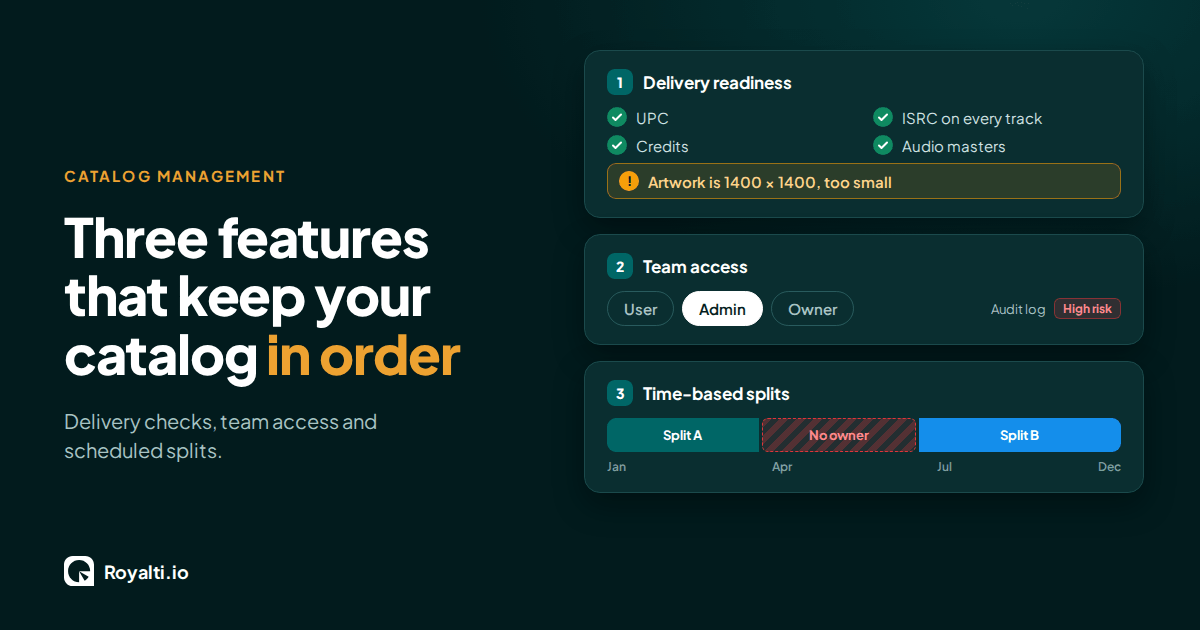
Royalti.io: Three Features That Keep Your Catalog in Order
Delivery checks that stop bad releases, team access you can trust, and splits that change on schedule. Here is how each one works in Royalti.io
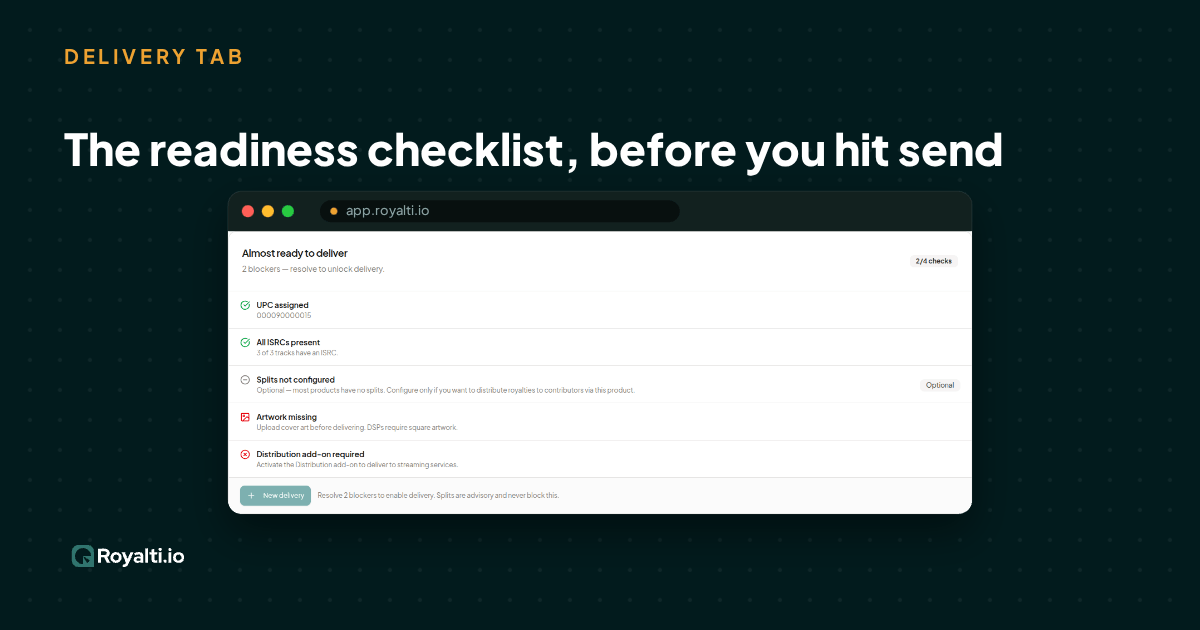
Royalti.io: How We Rebuilt DDEX Delivery
A release can fail on its way to stores without anyone noticing. Here is what broke in our DDEX delivery, how we fixed it, and what you can check first.
AI and Creator Consent 1: What Creator Groups Want From AI Music Deals
Learn why creator groups are demanding consent, fair compensation and transparency from AI music deals
Comments
No comments yet. Be the first to comment!