Most of What I Make in a Day is Now One Html File
A normal day's output — analyses, mockups, planning boards, reports — all single HTML files an agent wrote. Mock data anywhere; live data in the workspace.
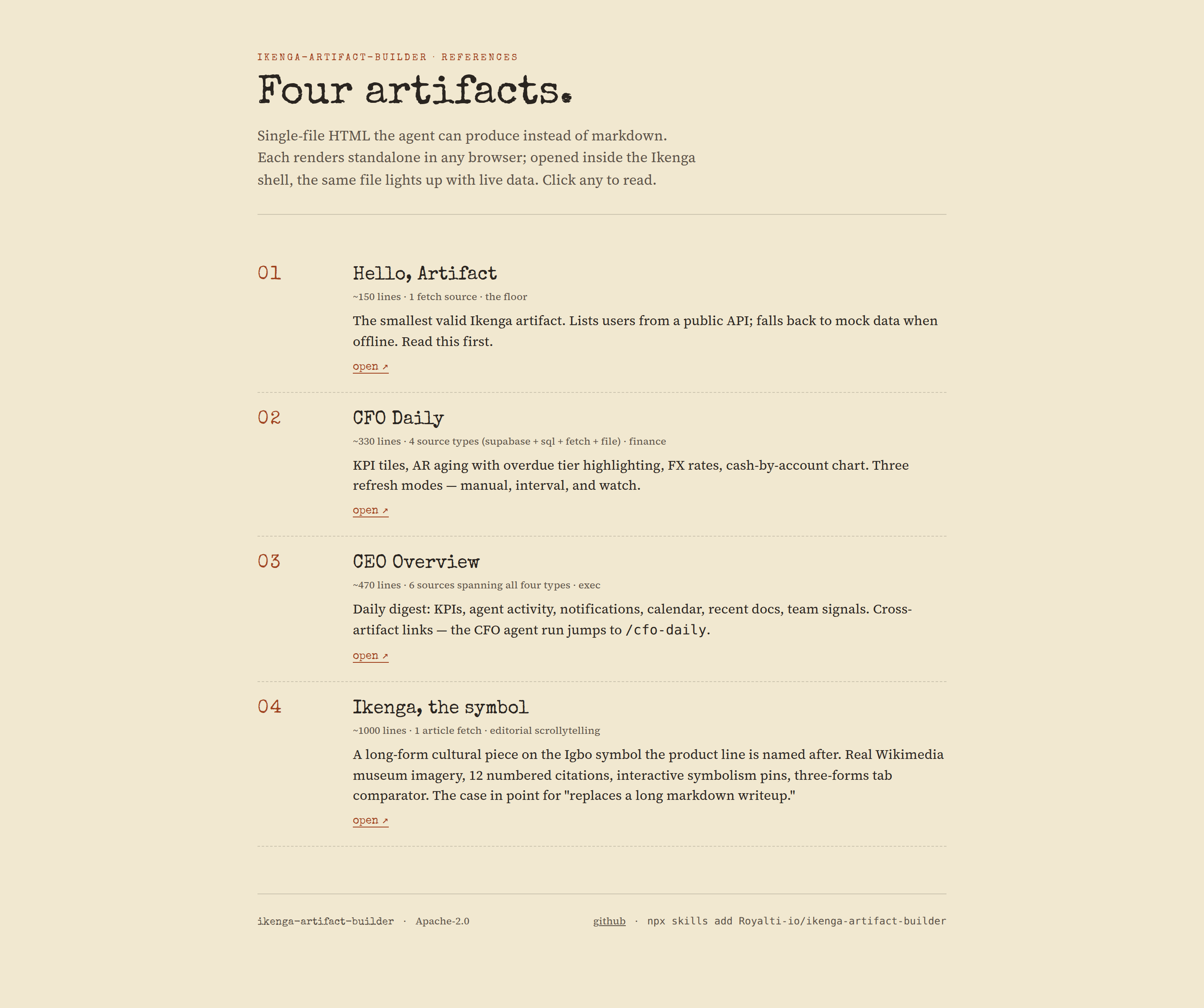
Founder 's-eye follow-up to Skills should produce artifacts, not markdown, the post where we open-sourced ikenga-artifact-builder and laid out the what and the why. This is the lived version: what using it every day actually looks like.
TL;DR: On a normal day, I'll make a repost card, a competitive analysis, a mockup, a groundwork board, and a report — and not one of them is a markdown file. They're single HTML files that an agent wrote with ikenga-artifact-builderthe skill we just open-sourced. Most don't even carry data; the portable single file is the win on its own. The data-bearing ones light up with live numbers inside the workspace. Two of them ship in the repo, so you can read every line. Install: npx skills add royalti-io/ikenga-artifact-builder
We open-sourced the artifact builder with a simple claim: an agent should hand you one HTML file instead of a markdown report. I've been living with it since, across far more than dashboards. Here's what that looks like once it's a habit rather than a demo.
I looked back at what I made yesterday. A card to repost a customer's launch. A competitor analysis with the pricing laid side by side. A mockup of a settings screen I was arguing with myself about. A groundwork board for a piece of work I'm scoping. A short report for a partner. Five things. Not one of them was a markdown file, and not one of them needed a design tool, a deploy, or a screenshot I couldn't edit later.
A year ago, every one of those would have been a different kind of friction: prose with a table buried in it, a design app I had to open and re-open, an image I couldn't change without starting over. Now they're all the same thing: a single HTML file an agent wrote, that I can open anywhere and hand to anyone.
The reference artifacts that ship with the skill, all four are live to click, no install. Each renders standalone in any browser; open it in the workspace, and the same file lights up with live data.
It isn't Only Dashboards
This is the part I didn't expect. I built the skill thinking about data; dashboards, status views, the things you refresh. But most of what I actually make with it carries no live data at all. A repost card is a static composition. A mockup is a static screen. An analysis is mostly a layout with the numbers typed in once.
For all of those, the win isn't live data; it's the format. One file. Opens in any browser and in Claude's own artifact viewer. No build, no deploy, nothing to keep running. I can send it to someone, and it just opens for them too. That alone replaced three different tools I used to reach for, depending on whether the thing was a chart, a design, or a doc.
The live-data part is the extra gear, and it kicks in only when the thing is data-bearing. A report I send a partner is static. A board I'm watching, or an analysis sitting on real numbers, isn't, and for those, the same file that shows mock data in my browser shows the live numbers inside the workspace. Same format either way. Data, when it earns its place, not as a tax on everything.
Two you can read
I don't want to hand-wave this, so here are two of the references the launch post lists, rendered so you can see they're real and not slideware. The announcement walks the manifest mechanics; I just want to show you the shape.
cfo-daily.html It is about 330 lines; KPI tiles, an aging table with the overdue rows in red, an FX line, and a cash chart. Double-click it anywhere, and it renders on mock numbers; open the same file inside the workspace, and the four sources it declares go live, under my own permissions. Same bytes, two behaviors, decided by where I opened it. It's the example I reach for when someone asks what a real one looks like.
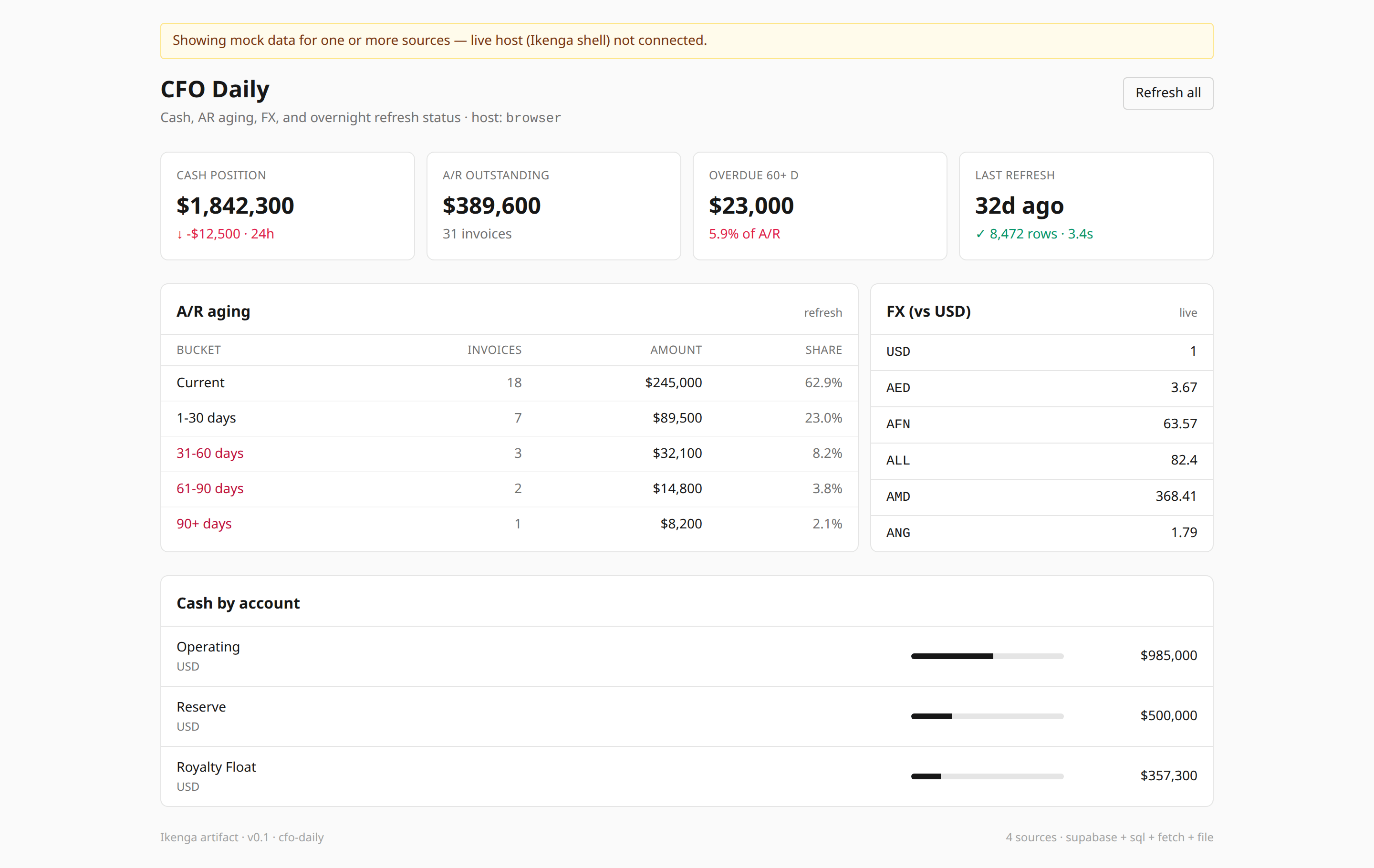
cfo-daily.html opened straight from a file path, no server, no workspace. Open it live. The banner up top is the honest tell that it's running on mock data; the footer reads "4 sources · supabase + sql + fetch + file." Open the same file in the workspace, and those four go live.
The other is bigger, about 470 lines, six sources spanning every source type the skill supports, more digest than chart. The detail I like most is small: when an agent run shows up in it, that row links straight into cfo-daily.html. One artifact addressing another, the way pages link to pages. Read both before you write your own; they're the real thing, not a marketing demo.
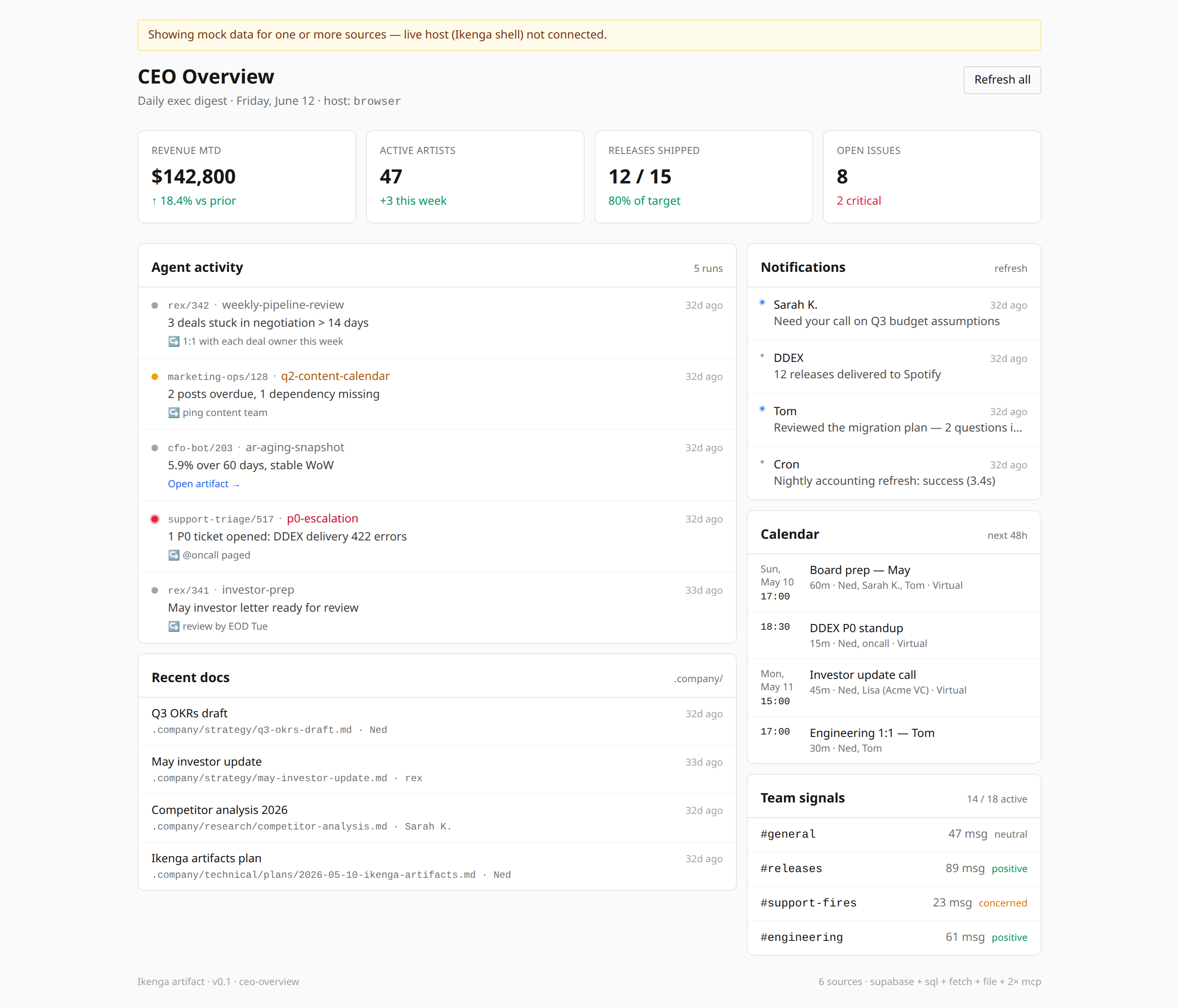
ceo-overview.html Six, which sources, more digest than chart. Open it live. The CFO agent's row carries an "Open artifact →" link straight into cfo-daily.htmlthe footer, which, reads "6 sources · supabase + sql + fetch + file + 2× mcp."
The Boards are Artifacts, Too
The planning skill we open-sourced a couple of weeks back: groundwork, builds a board, and that board is one of these. It opens in any browser and shows live status inside the workspace. The two skills weren't designed as a pair. The board is an artifact, because a single portable file is the right shape for a thing you want to open, share, and refresh. That's the tell that the format is doing real work: I keep reaching for it without deciding to.
What It Costs
The live data only resolves inside the workspace. Everywhere else, a plain browser, a chat, a file I sent someone, the data-bearing ones run on the mock copy with a banner. That's honest, and it's the right default, but the file I email you is a faithful preview, not my live numbers.
The sources are read-only. An artifact shows you a number; it doesn't write one back.
And it won't give you taste. The mockup I made yesterday took a few rounds. The first cut put the primary action in the wrong place, and I had to say so. The skill makes the format right. What goes on the page is still a conversation.
About the author
Keep reading
All posts →
Royalti.io: Three Features That Keep Your Catalog in Order
Delivery checks that stop bad releases, team access you can trust, and splits that change on schedule. Here is how each one works in Royalti.io
Royalti.io: How We Rebuilt DDEX Delivery
A release can fail on its way to stores without anyone noticing. Here is what broke in our DDEX delivery, how we fixed it, and what you can check first.
AI and Creator Consent 2: Before You Opt In to an AI Music Deal
Your distributor or publisher may already have the right to license your music for AI use. Here is what to ask and what to check for before you say yes.
Comments
No comments yet. Be the first to comment!