Cross-Border Royalty Collection: How a Nigerian Artist Actually Gets Paid for a UK Tour or European Streams
Nigerian music is generating royalties in the UK and Europe right now. Whether those royalties reach you depends on what you have registered and what you haven't.
They say experience is the best teacher, and those words have never rung truer for an artist who is awaiting their very first international payment. Because here is what no one will tell you: the delays you may experience along the way are mostly systemic, and there are many points where your money can get stuck along the way. So let’s talk about it: the intricacies of cross-border royalty collection. What you need to know to navigate this new level, if not seamlessly, then knowledgeably.
A Weave of Networks
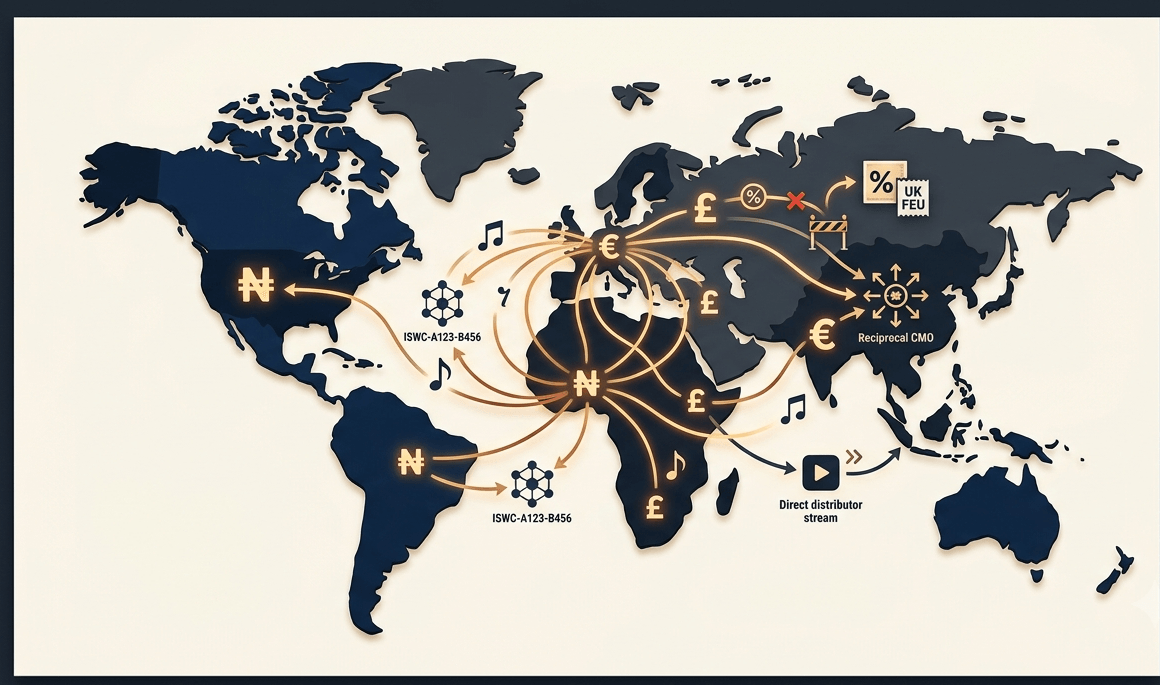
A touring fee, a songwriting royalty, and a streaming royalty; each of these takes a different path to make its way back to you. The infrastructure that allows cross-border royalty collection is largely dependent on a global network of reciprocal agreements between collection societies. Now that we have established that, let us address each income stream in turn.
The Touring Fee
If you are going to be touring Europe, specifically the United Kingdom, then you should be aware of the good old 20%. This comes from the Foreign Entertainers Unit (FEU) of the HM Revenue and Customs, which requires the promoter of the tour to withhold 20% of your fee before you are paid, an advance payment to cover whatever you may owe in UK tax.
Now, Nigeria and the UK do have a double taxation treaty which ensures that the same income is not taxed twice. If a Nigerian resident entertainer is taxed at 20% in the UK, that tax paid is allowed as a credit against the Nigerian personal or company income tax payable on the same income.
However, because this relief is limited to the lower of Nigeria’s effective tax calculation, you cannot simply inform the Federal Inland Revenue Service (FIRS) that you paid tax in the UK, and all will be well. No. To avoid being taxed on the same income twice, you have to file for these reliefs and provide documented proof of the exact amount the UK government withheld. In this regard, a tax advisor should be consulted.
What should you keep track of?
How much the gross fee is, how much was actually withheld, and whether a double taxation relief has been filed. All necessary questions to make sense of how much money actually lands in your account.
The Songwriting Royalty
Streaming and radio play in Europe generate a separate royalty for the composition itself, and this is owed to the songwriter. This is collected through collecting societies; in Nigeria, these are called Collection Management Organisations (CMOs). Where collection needs to happen internationally, CMOs have reciprocal agreements with their counterparts abroad. Your registered collection organisation acts on your behalf and is essentially vouching that you own the rights to the composition in question.
Take COSON as an example: it has reciprocal agreements with over 100 collecting societies worldwide, is a member of both the International Confederation of Societies of Authors and Composers (CISAC) and Bureau International des Sociétés Gérant les Droits d’Enregistrement et de Reproduction Mécanique (BIEM).
And the logic is quite simple: COSON cannot monitor and collect royalties from every venue or broadcaster in every other country, so it simply enters into reciprocal agreements with those countries’ collection societies instead. When music from one territory generates royalties in another, the local collection society collects and routes the money back through the agreement to the rights holder’s home society, which then pays the artist.
It is important, however, to emphasize that no matter how connected these societies are, the system only works when your song is registered correctly. If your ISWC (the code that identifies your composition) is missing, or your name is spelled differently across two databases, it becomes difficult to match the royalties to the rights holder.
What should you keep track of?
Ensure your works are registered with a CMO, and that the metadata matches what DSPs and foreign societies have on file. Remember that an unclaimed royalty is simply black boxed at the end of the day.
The Streaming Royalty
Here, the process for royalty payments is more direct than the first two. When you distribute your music on platforms like Spotify and Apple Music, those platforms pay your distributor or label directly, per their existing commercial agreement. Your distributor then pays you, per your deal with them.
There is no need for CMOs or reciprocal agreements here. The complication starts at the distributor level, not the platform level. Distributor payment schedules, territory coverage, and the size of the distributor’s cut will vary from distributor to distributor. Most royalty statements arrive fragmented and non-standardised, difficult to reconcile without a management system built for the purpose.
The crux of the matter, however, is that streaming rates vary by territory. UK streams pay at UK rates while Nigerian streams pay at Nigerian rates, a direct reflection of the difference in subscription pricing between markets. This is why building an international audience may be economically strategic for Nigerian artists. And it seems to be working. In 2025, Spotify royalties paid to Nigerian artists exceeded ₦60 billion, Spotify royalties paid to Nigerian artists exceeded ₦60 billion, more than double the figure from two years prior.
What should you keep track of?
What your distributor’s payment schedule is, what territories your distributor covers, and whether your royalty statements account for all the markets your music is reaching.
Conclusion
Ultimately, your experience navigating cross-border royalty collection is determined by how well you have eliminated unnecessary complexity. A UK show and a US-platform stream would each clear through a completely different system; one built on tax law, the other on individual commercial contracts, and the songwriting royalty somewhere in between, built on a global network of reciprocal registrations.
An artist who earns from multiple international sources needs a reliable way to track and verify each of these income sources in one place. Royalti.io pulls royalty data across these sources into a single view, so a missing registration or an unclaimed withholding shows up at a glance. Who knows, you might just discover where your own international royalties might be stuck.
Note: This article is for informational purposes only and does not constitute legal or financial advice.
About the author
Keep reading
All posts →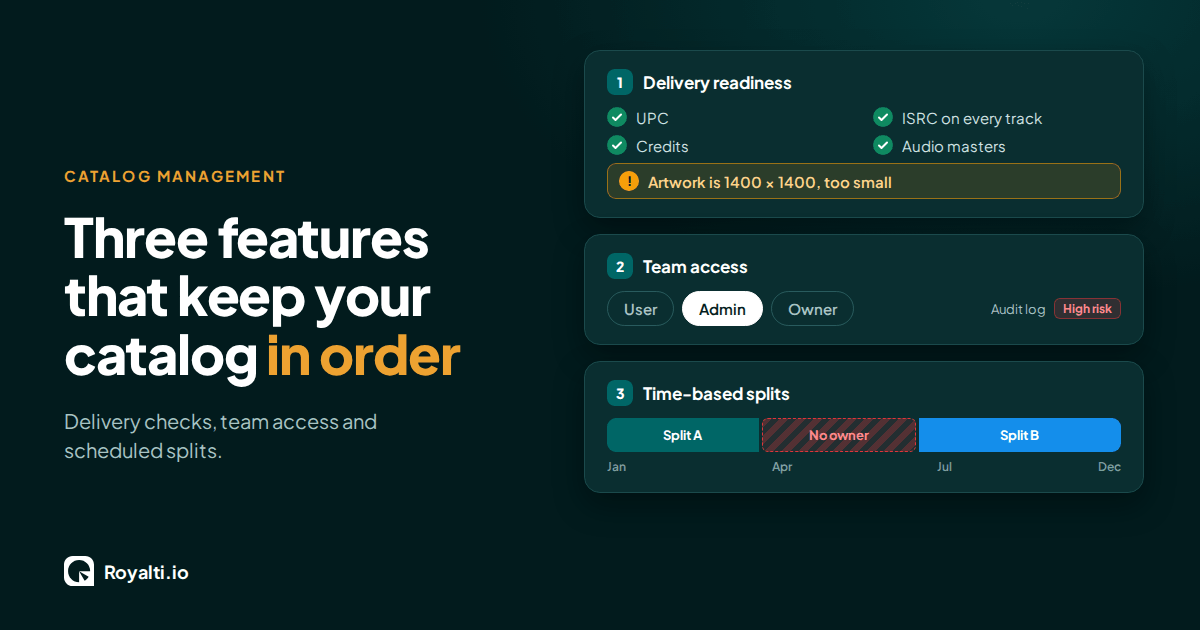
Royalti.io: Three Features That Keep Your Catalog in Order
Delivery checks that stop bad releases, team access you can trust, and splits that change on schedule. Here is how each one works in Royalti.io
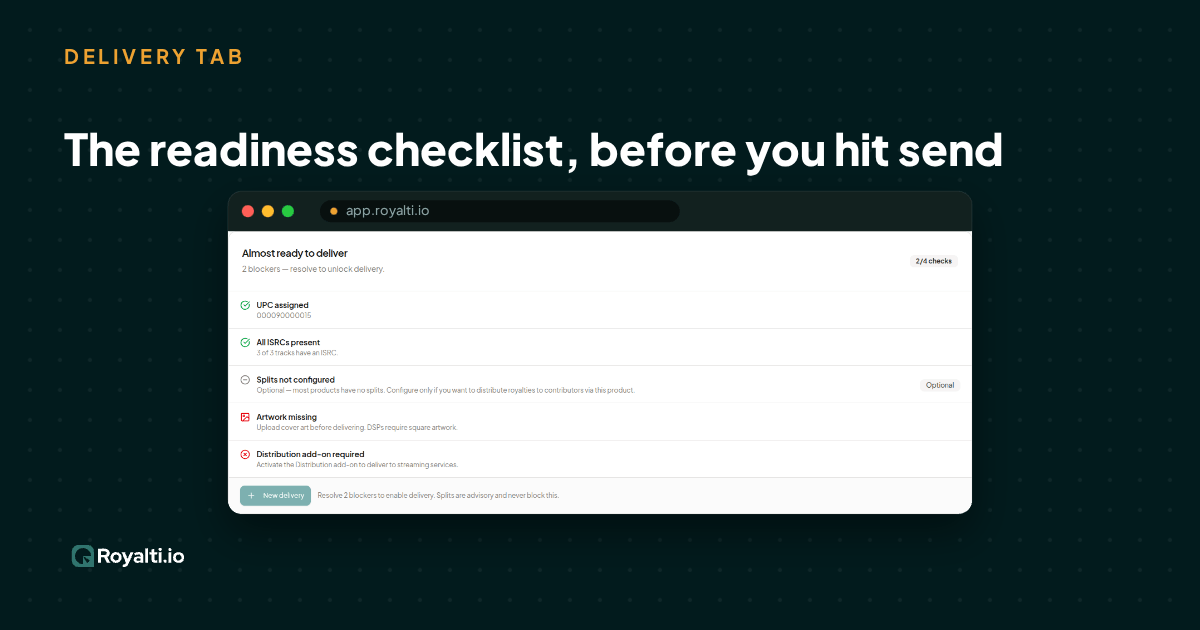
Royalti.io: How We Rebuilt DDEX Delivery
A release can fail on its way to stores without anyone noticing. Here is what broke in our DDEX delivery, how we fixed it, and what you can check first.
AI and Creator Consent 1: What Creator Groups Want From AI Music Deals
Learn why creator groups are demanding consent, fair compensation and transparency from AI music deals
Comments
No comments yet. Be the first to comment!