Co-Writing Agreements: What to Agree Before You Enter the Studio
Undocumented collaboration is a source of conflict in the music industry. We discuss what a co-writing agreement is, why it matters, and what it should contain.

“So, if I write this verse, then you take this hook; the melody will go like this, while I take the whole of this part. Sounds good?”
In the music industry, collaboration is gold, and most hit songs are not written alone. When two or more creatives come together, each contributing their unique talent, style, or technique to a project, it is just the right recipe for a hit. The stuff dreams are made of.
But that dream can easily take a wrong turn, because while collaboration is good, undocumented collaboration is one of the most reliable sources of conflict in the music industry. Let’s discuss.
The Making of a Hit
Sometimes it takes a village. Sometimes the contribution could be just suggesting a chord change or perhaps rewriting the bridge in the middle of the night while everyone else is asleep. Who’s counting, right?
Well, you should be. Because the trouble, if any, does not start immediately. A little time has passed, and the song becomes a hit, and suddenly, the accounts of who did what, when, and where can no longer be unanimously agreed upon. And this is not us pre-empting discord; the industry is rife with stories like this. Two producers squabbling over vocal compositions or a beat they had created together in an undocumented label session, an artist taking a producer’s undocumented work-in-progress track to an in-house label producer to re-record, altering the beat without consent, or a producer fighting to be credited retroactively for production contributions made to an album.
A co-writing agreement is not a sign of distrust. On the contrary, it is the document that protects the collaboration itself.
What Happens When Collaborations are undocumented
Under Nigerian copyright law, the default position for a co-written work is joint ownership. The Copyright Act 2022 recognises joint authorship, and Section 30(5) provides that an assignment of copyright granted by one co-owner has effect as if granted by the other, subject to any contract between them. You see that phrase “subject to any contract between them”, that is where the problem begins.
To dispel confusion, we will keep this as simple as possible. If two contributors have a co-writing agreement and they go on to make a song together, any subsequent assignment or exclusive licence of their shared rights in that song will always be subject to their existing agreement. However, where there is no agreement and one contributor decides to transfer the rights to that song, the law says that the transfer has effect as if it were granted by both contributors. This is why the specific terms of any exploitation need to be agreed upon beforehand.
Now, let’s be clear, as a co-owner, you have every right to legally challenge any claim that does not represent your rights or interests in a work. But what that does is that while disputes are being resolved, royalty payments stall, deals are halted or lost entirely, and it ultimately serves no one in the long run. You cannot wait for the song to become something worth fighting over, so state things clearly from the very beginning.
More Than a Piece of Paper
As Afrobeats continues to expand into a global phenomenon, collaboration is inevitable. Sessions often involve multiple producers, songwriters, featured artists, and session musicians all working together, sometimes across different countries, which can create the perfect conditions for disputes when nothing is documented.
As a music professional, you cannot afford to approach collaborations based merely on oral understanding. There is nothing unusual about shared ownership of a musical work, but that ownership structure cannot exist solely in the memories of the people involved; it must be given a physical form.
What a Co-Writing Agreement Should Contain
You might ask what the difference is between a co-writing agreement and a split sheet. A split sheet records the names, information, and contributions of each contributor, the minimum documentation for a collaborative session. A co-writing agreement goes further: it sets the terms for how, and under what circumstances, the work can be exploited. Because any future dealings with the work must be subject to this agreement, the parties are usually more precise about the details. Therefore, a co-writing agreement should typically cover:
Ownership Percentages
The agreed split for each contributor, which can be equal, weighted by contribution, or negotiated on any criteria the parties agree to, so long as it is stated clearly, agreed to, and signed.
Each Contributor’s Details and Contributions
Legal names, contact information, and CMO or PRO memberships. The nature of each contribution determines which royalty streams each contributor is entitled to claim, and the personal information facilitates accurate royalty collection and distribution.
Interpolations and Samples
Where the work contains elements of a pre-existing work and a third-party royalty share needs to be accommodated in the splits, the agreement should state this explicitly.
Exploitation Rights
Who can authorise the work to be licensed? How may the work be exploited? Under what circumstances can the exclusive rights be assigned? These are details that can be agreed to mutually, even before the project is complete.
The list is not exhaustive, but it gives a clear sense of what needs to be considered when preparing to sign a co-writing agreement. Collaboration is crucial in the industry, and conversations about legal documentation do not have to be awkward once all parties understand that it is a necessity, one that protects the creative relationship for years to come.
Note: This article is for informational purposes only and does not constitute legal advice.
About the author
Keep reading
All posts →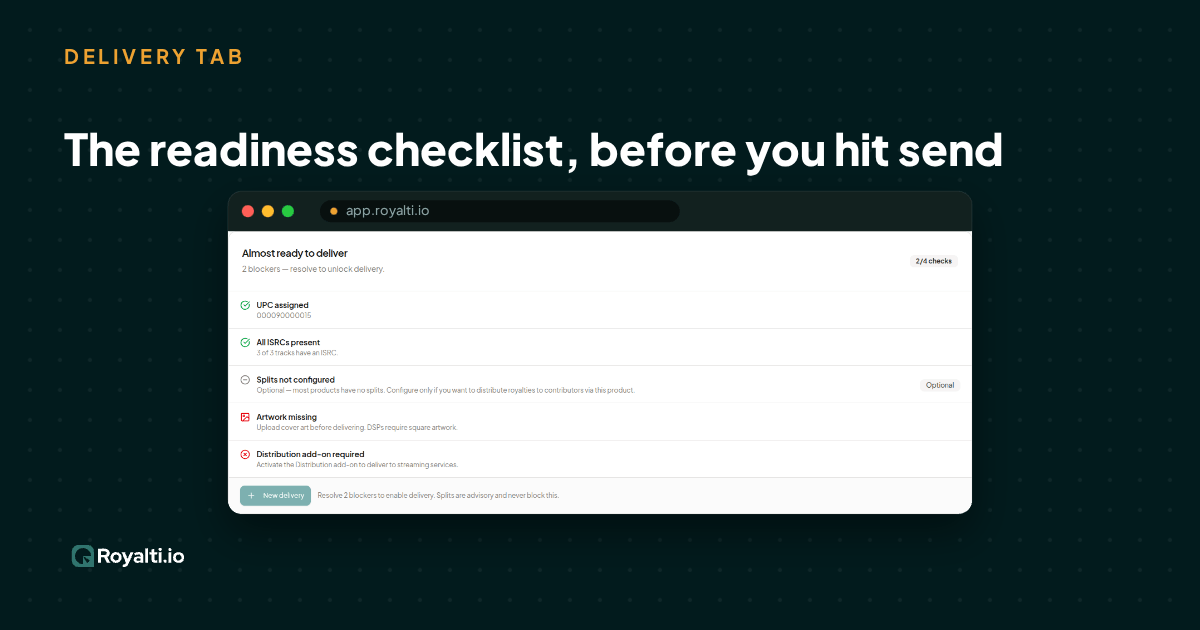
Royalti.io: How We Rebuilt DDEX Delivery
A release can fail on its way to stores without anyone noticing. Here is what broke in our DDEX delivery, how we fixed it, and what you can check first.
AI and Creator Consent 1: What Creator Groups Want From AI Music Deals
Learn why creator groups are demanding consent, fair compensation and transparency from AI music deals
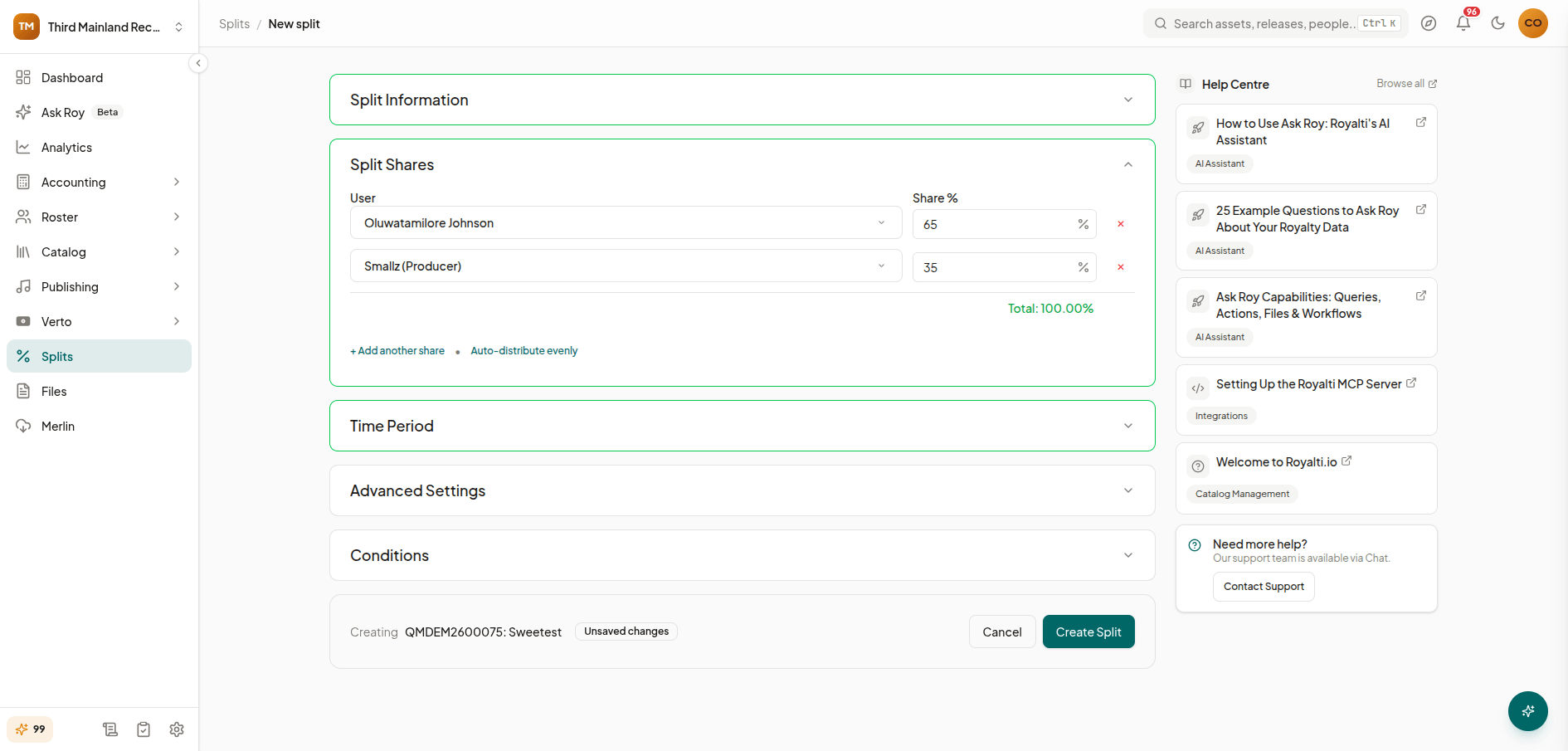
Time-Based Splits: How to Schedule Ownership Changes on Royalti.io
When a split change depends on someone remembering to make it, it gets missed. Royalti.io's time-based splits let contract terms live inside the system that pays out against them
Comments
No comments yet. Be the first to comment!