ISRC and ISWC Codes: A Practical Guide to Getting Your Metadata Right
A missing or mismatched ISRC or ISWC code can cost you streaming income. Here is how to check whether your metadata is leaking money.
Metadata errors and inaccuracies are among the primary causes for lost streaming income. A song can rack up thousands of streams, and yet the rights holders may get nothing at the end of the day. And this can all be traced back to a missing or mismatched ISRC or ISWC code. So how do you check whether yours is costing you money?
First Things First: What Does an ISRC Actually Identify
An ISRC (International Standard Recording Code) identifies one specific recording. Call it an identification number for an exact mix or master. It looks like this: US-S1Z-24-00123, encoding the country, registrant, year, and a unique number sequence at the end.
Each version of a song should have its own ISRC. Whether it's an album cut, radio edit, acoustic version, or remix, each is considered a distinct recording, and each needs its own code. When two different recordings share one ISRC, streaming platforms cannot tell them apart. Plays from one version get folded into the other's count, and royalties follow whichever recording the platform decides is "the real one," and if you are unlucky, it may not decide at all.
What About ISWC
ISWCs (International Standard Musical Work Codes) identify the underlying composition, and these codes are attributed separately from the recording. One song can have a dozen recordings, each with its own ISRC (covers, remixes, samples), but it will have only one ISWC.
It follows a T-NNNNNNNNN-C format, and PROs and CMOs use it to route performance and mechanical royalties to songwriters and publishers. Without one, or with several conflicting ones on file, a royalty collection organization cannot confidently match a performance to a songwriter. When this happens, the money just sits in an unclaimed pool, sometimes until the paperwork gets sorted out, sometimes indefinitely.
So, where Does Each Code Come From
ISRCs are usually assigned by your distributor or label at the point of release, so you rarely have to request one yourself. However, self-releasing artists without a distributor can register with national ISRC agencies. For Nigeria, that is the Record Label Proprietors Initiative (ReLPI), formally recognized in 2026 as the official ISRC Registration Agency for Nigeria by the IFPI. Nigerian artists and labels now have a national body maintaining a localized database.
ISWCs, on the other hand, work a bit differently. They are assigned when you register a composition with a PRO or CMO: think COSON, MCSN, ASCAP, BMI, PRS, and similar bodies, or through a publishing administrator. The code is not assigned automatically; it follows a deliberate registration of the work.
So, while releasing a song gets it an ISRC, a composition must be registered to receive an ISWC. Two separate registrations and two separate systems.
Where the Metadata Breaks
When a remix or live cut goes out under the original recording's ISRC, without its own code, every stream gets attributed to the wrong version. The person who worked on the new version earns nothing from it.
When a composition was never registered for an ISWC, performance and mechanical royalties will pool up as unclaimed "black box" revenue instead of reaching the songwriter.
Lastly, when the same recording carries different ISRCs on different platforms, which usually happens after a re-release or a switch between distributors, there can be no accurate royalty reporting. The income stays fragmented, with no single statement ever showing the real total.
Then Come the Splits
ISWC problems get worse the moment more than one person is credited on a composition. Because PROs can only pay out royalties according to whatever split percentage was registered against an ISWC, if a song has three co-writers but the ISWC on file only lists one, only one person is getting the money. This is why registration information must be updated whenever a split changes.
What You Can Do
Three checks you should run on your catalog today:
- Check your last release in your distributor's dashboard. Does every version carry its own individual ISRC?
- Search your song title in your PRO's public catalog. Does an ISWC come back, and does it match correctly?
- Compare the ISRC for the same recording across two different streaming platforms. Do the two codes match?
An inconsistent answer to any of these questions is a potential revenue leak.
How Royalti.io Handles This
Royalti.io pulls ISRC and ISWC data automatically with every royalty import and flags gaps before they turn into missing payments, so you don’t have to reconcile them manually every time a statement comes in. The platform is already tracking royalties for over 2,000 artists and labels, managing catalogs from a handful of singles to thousands of tracks. Fixing metadata gaps is not a separate project on that platform. It is just part of how it works.
See whether your own catalog has a metadata gap by running a free check on Royalti.io today.
About the author
Keep reading
All posts →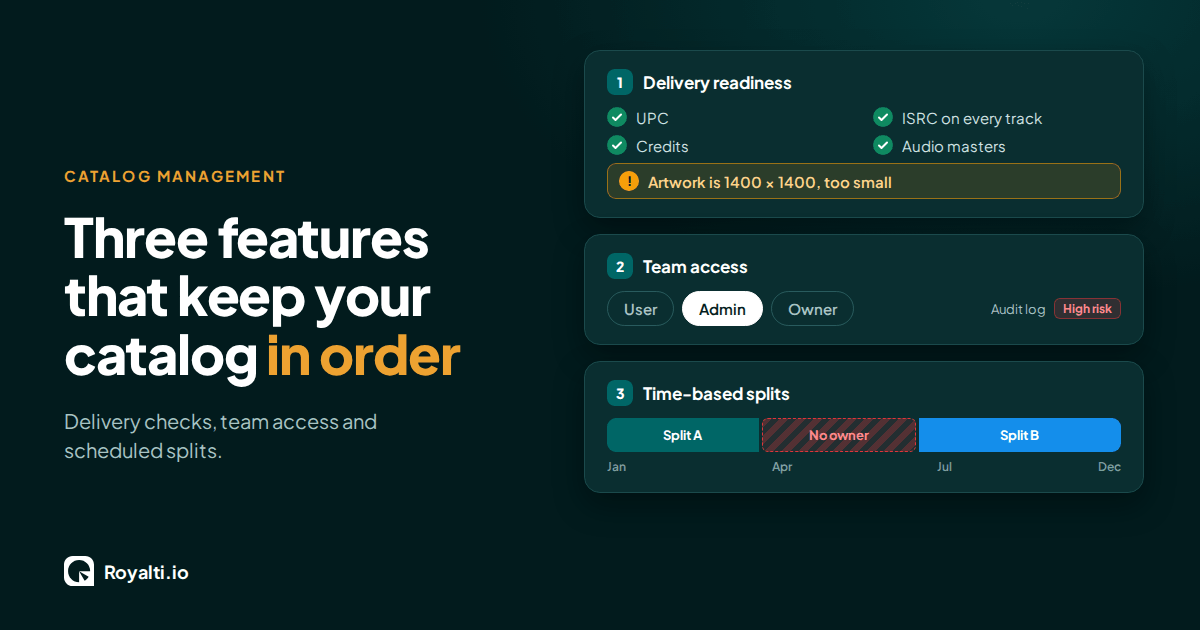
Royalti.io: Three Features That Keep Your Catalog in Order
Delivery checks that stop bad releases, team access you can trust, and splits that change on schedule. Here is how each one works in Royalti.io
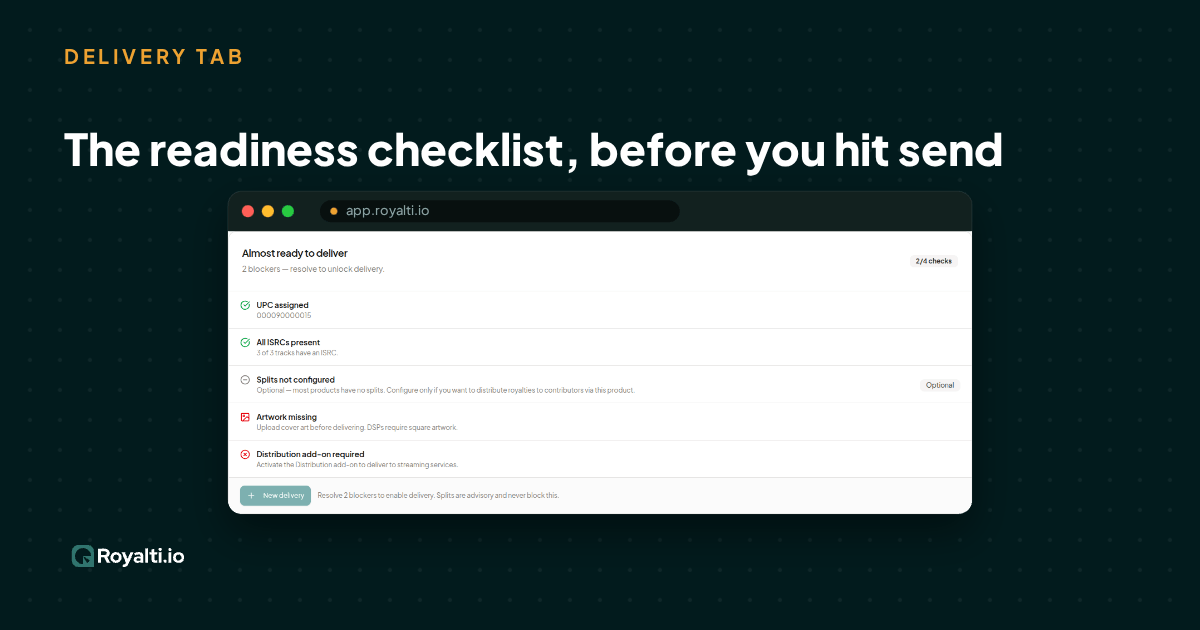
Royalti.io: How We Rebuilt DDEX Delivery
A release can fail on its way to stores without anyone noticing. Here is what broke in our DDEX delivery, how we fixed it, and what you can check first.
AI and Creator Consent 1: What Creator Groups Want From AI Music Deals
Learn why creator groups are demanding consent, fair compensation and transparency from AI music deals
Comments
No comments yet. Be the first to comment!