AI and Creator Consent 2: Before You Opt In to an AI Music Deal
Your distributor or publisher may already have the right to license your music for AI use. Here is what to ask and what to check for before you say yes.
This is part 2 of 2 on AI and Creator Consent. Part 1: What 31 Creator Groups Want From AI Music Deals.
There is no denying it: AI licensing deals are part of the industry now. What that means for you is largely dependent on the nature of your agreement. The meaning of "opt-in," for example, can differ significantly depending on the creator or the subject matter involved. So, before you say yes, know what you are agreeing to and which rights you are signing off on. We put together a checklist: seven questions to ask about a deal before you decide.
A Conversation You Cannot Ignore.
AI is here, and as an artist, you cannot afford to close your eyes to it and hope it goes away. As we mentioned in part 1, major players have been signing licensing deals with AI music companies at a steady pace. Just as a refresher:
- Merlin and Kobalt with ElevenLabs, 2025.
- Warner Music Group with Udio, November 2025.
- Merlin with Udio, January 2026.
- Kobalt with Udio, April 2026.
- Universal Music Group with ElevenLabs, September 10, 2026.
Some of these deals are described as opt-in, but details available to the public are thin, and each deal has to be viewed on a case-by-case basis. If you are an independent artist, the offer may reach you through your distributor, your publisher, or the AI company directly. Whichever route it takes, the questions below still apply.
Opt-in, to What Exactly?
Warner's CEO has said artists and songwriters can choose whether their name, image, likeness, or voice is used in new AI-generated songs. Okay. But what about training the AI models themselves? Recordings, compositions, and human-created works used as learning data to ensure that any AI output is worth anything in the first place. Creator groups say that needs explicit consent as well. So while conversations are ongoing on all fronts, and the industry is shifting to find balance, here are the questions to tick off, just to be sure you understand that deal.
Seven Questions Before You Say Yes
1. Which rights does it cover? Voice and likeness, recordings, compositions, training data, or the AI's outputs.
2. Who is actually consenting? Check whether your label, distributor, or publisher can agree on your behalf, or whether it requires your direct sign-off.
3. Can you say no? Whether declining has consequences and what those consequences are.
4. How is the money split? Ask what percentage goes to you, to your label or publisher, and to the AI company.
5. Who owns what comes out? Analysts covering the UMG and ElevenLabs deal have flagged that ownership of fan-made remixes remains an open question. Ask how outputs are to be licensed and credited.
6. How long does it last? Look for a defined term and a renewal clause, and ask what happens to content already generated if you leave.
7. How will it show up in your statements? AI income is a new revenue source. Ask your distributor how it will show up in your statements so you can identify it.
Watch for vague wording, no end date, no way to withdraw, or a refusal to share percentages. Remember, you can always pause to ask questions and get clarity. If you have already received a letter, do not ignore it. Some notices carry a deadline, and silence may count as agreement under your existing contract. Read what it says you are enrolled in, note the date and any opt-out window, and get a lawyer to read any agreement, even the ones that seem plain enough to understand.
Keep Your Records Ready
Determining ownership can get complex when there are multiple writers, a producer, a label, and a publisher to factor in. Royalti stores splits and ownership for every track and brings your statements together across platforms, so new income sources are easier to spot.
Get your ownership record in order before the next offer arrives. Track your catalog's splits for free.
This post is general information, not legal advice. For a specific agreement, talk to a lawyer.
About the author
Keep reading
All posts →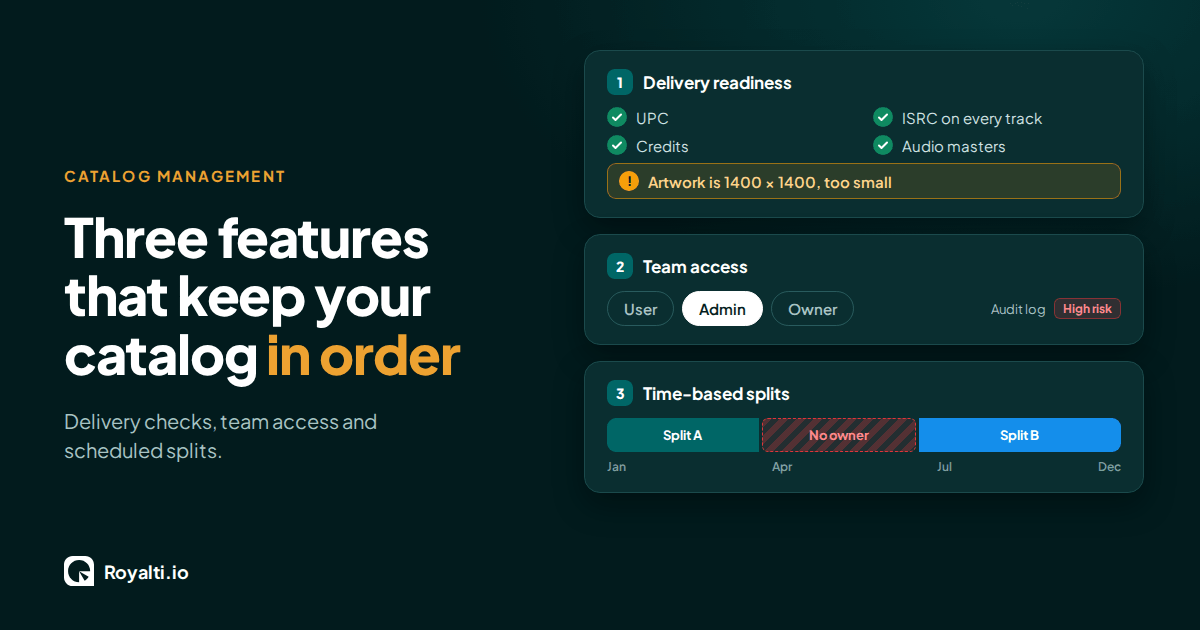
Royalti.io: Three Features That Keep Your Catalog in Order
Delivery checks that stop bad releases, team access you can trust, and splits that change on schedule. Here is how each one works in Royalti.io
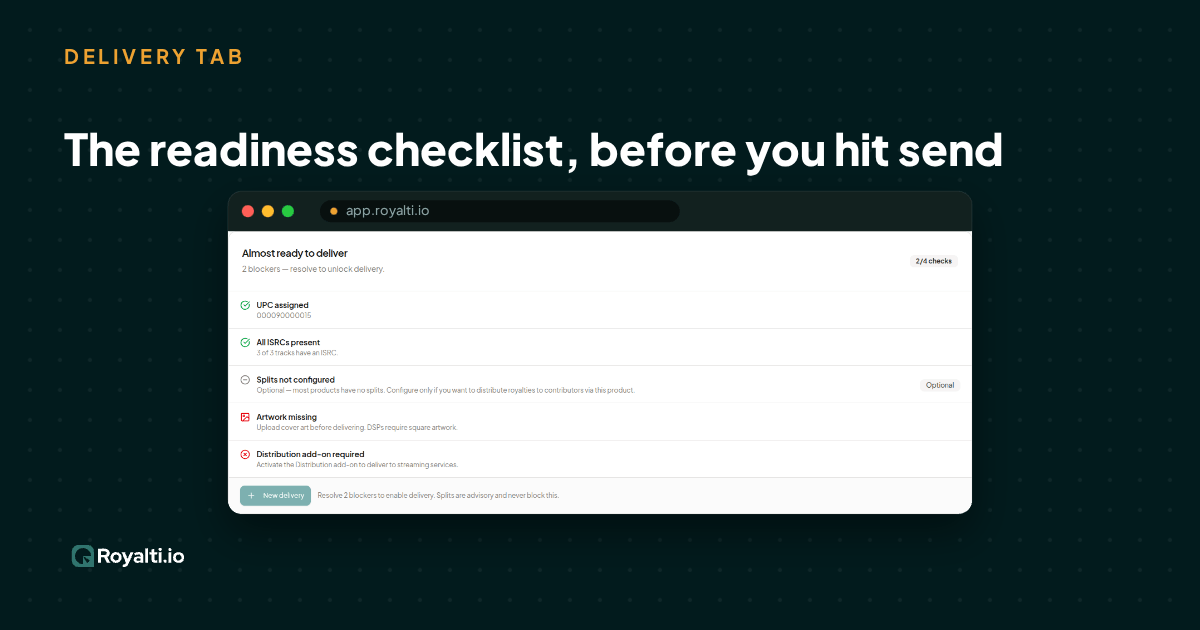
Royalti.io: How We Rebuilt DDEX Delivery
A release can fail on its way to stores without anyone noticing. Here is what broke in our DDEX delivery, how we fixed it, and what you can check first.
AI and Creator Consent 1: What Creator Groups Want From AI Music Deals
Learn why creator groups are demanding consent, fair compensation and transparency from AI music deals
Comments
No comments yet. Be the first to comment!