5 Music Tech tools and Services You Can't Afford To Ignore
Five important music technology tools every modern creator should know, from DAWs and AI assistants to collaboration and royalty management platforms.

5 Music Tools to Keep Your Eyes On
As a professional or independent artist, there is a growing demand for your skills to evolve beyond the role of a mere creative. This means being aware of and even mastering technological advancements, specifically digital tools that are vital for your success in this day and age. From composition to royalty collection, technology has changed how creators work, simplifying once complex processes. Yet, all that innovation means little if we lack the knowledge to use it effectively.
Today, we spotlight technologies that have become essential for creators seeking to remain competitive in the music industry.
Digital Audio Workstations (DAWs)
The Digital Audio Workstation (DAW) is indispensable software for musicians, producers, and sound engineers. It allows users to compose, arrange, record, mix, and master audio within a single environment. Over time, DAWs have evolved to make professional-grade recording and mixing tools accessible to virtually anyone with a computer. This evolution has drastically lowered the technical and financial stakes for music creation.
Numerous platforms can be cited as examples of DAWs, such as Logic Pro, Ableton Live, and Reaper. While their interfaces and features might differ, the core functions of sequencing, mixing, and editing remain consistent.
AI Music Generation and Assistance
It may not be everyone’s cup of tea, but we can’t ignore the growing presence of Artificial Intelligence (AI)in music. AI tools are increasingly integrated into the creative supply chain, offering remarkable efficiency in both music creation and post-production.
They can generate new compositions in seconds, streamline processes like mastering, executing precise equalization (EQ), compression, and limiting all within minutes. For some, it is the ultimate creative partner; for others, it symbolizes a threat to human artistry, trivializing creativity.
Regardless of one’s stance, AI tools serve as efficiency accelerators. A notable example is AIVA, designed specifically for music generation. It can quickly produce melodies, chord progressions, or even full tracks, offering immediate inspiration to both professionals and beginners.
While the technical benefits of AI are clear, legal uncertainties, particularly concerning intellectual property (IP) rights and ownership of AI-generated works, remain the biggest headache in its adoption.
Music Distribution Services
Once the music is ready, the next step is distribution. Distribution connects the finished product to listeners worldwide. Most of this process now happens digitally. Music distribution service providers facilitate the seamless delivery of tracks to major music stores and streaming platforms worldwide.
Choosing a distributor will depend on several factors, including business model, global reach, connections, and budget. Many platforms providing these services allow independent creators to distribute their work with ease, but selecting a distributor is a strategic business decision. It involves choosing a long-term partner who will represent your music commercially, so the decision should be made with utmost care and consideration.
Collaboration Platforms
As music production teams become more globally dispersed, collaboration platforms have become a necessity. From Pibox Music to Bandlab and others, these tools provide virtual studio environments that allow creators to collaborate in real-time, regardless of their geographical locations.
They include features such as live chat, secure file sharing, mix versioning, and waveform commenting, which lets collaborators leave time-stamped feedback directly on an audio timeline. Some platforms also integrate with professional tools and cloud storage systems for seamless workflow management.
Because creative work requires constant iteration, miscommunication can slow progress. These platforms act as virtual project managers, improving communication, streamlining revisions, and ensuring projects are finished faster and more effectively.
Royalty Management
After the music is released, the next challenge lies in tracking and managing revenue, otherwise known as royalties. Keeping track of royalties, especially from thousands of streaming services and markets, requires sophisticated Royalty Management Platforms to stay organized.
These platforms automate the tracking, calculation, and recording of royalties, ensuring that every stream and sale is properly accounted for. Advanced systems can also manage complex contracts, generate payment statements, and produce real-time financial reports.
Royalti.io is one of such platforms that combines knowledge of the music business with modern accounting and technology, simplifying complex royalty calculations and offering valuable insights through data analysis.
Conclusions
Today, success in the music industry requires not just talent but technical fluency and business intelligence. Creators must adopt tools that integrate seamlessly, reducing manual work and maximizing creative time.
The modern challenges facing the creator are no longer how to make music, but rather how efficiently that music can be produced, distributed, discovered, and monetized.
Keep reading
All posts →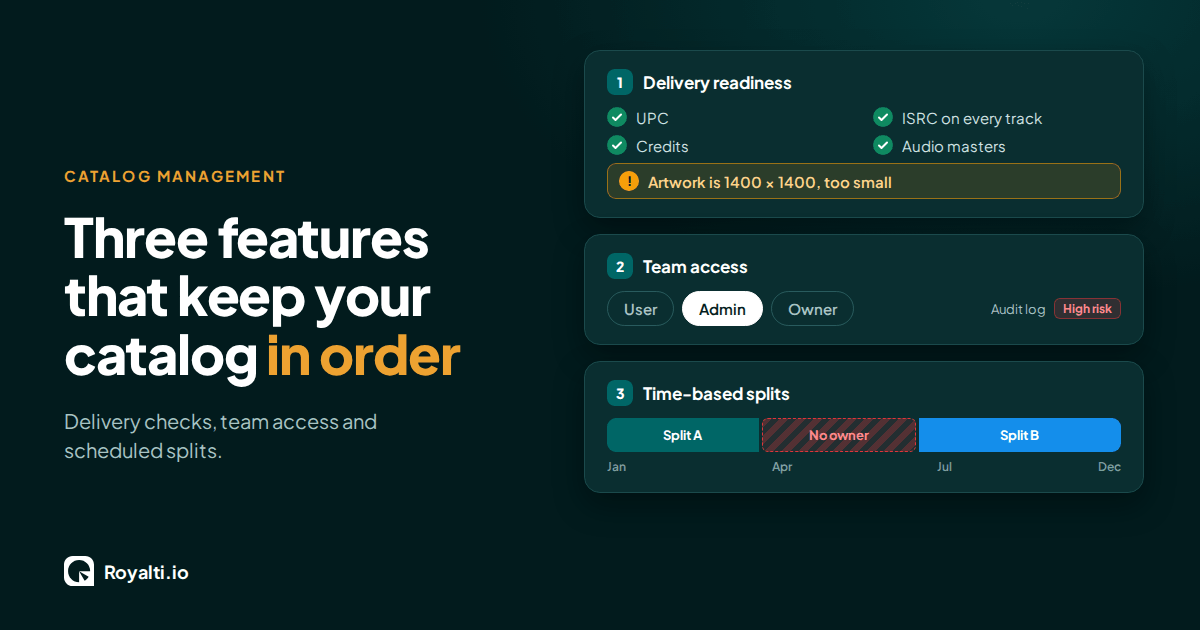
Royalti.io: Three Features That Keep Your Catalog in Order
Delivery checks that stop bad releases, team access you can trust, and splits that change on schedule. Here is how each one works in Royalti.io
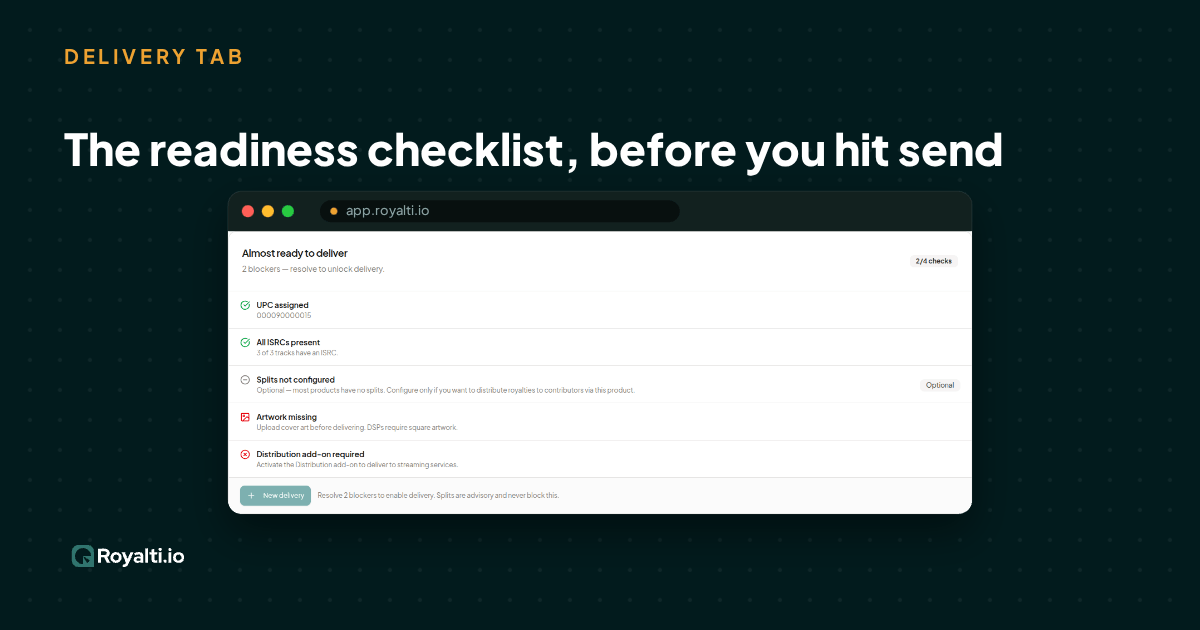
Royalti.io: How We Rebuilt DDEX Delivery
A release can fail on its way to stores without anyone noticing. Here is what broke in our DDEX delivery, how we fixed it, and what you can check first.
AI and Creator Consent 1: What Creator Groups Want From AI Music Deals
Learn why creator groups are demanding consent, fair compensation and transparency from AI music deals
Comments
No comments yet. Be the first to comment!