Music Royalty Collection in Nigeria: Laws, Challenges and Solutions
Learn how music royalties are collected in Nigeria, the laws that govern them, the role of CMOs, and how technology could solve...
Explain the concept of music royalty collection in Nigeria; how royalty can be collected, and identify the parties responsible for this process. Address the challenges that hinder effective royalty collection and how technology could offer lasting solutions. That is the core of today's discussion.
Let’s begin by defining what royalties are, and also the different types of music royalties.
What are royalties
Royalties are revenue earned from the authorized use, licensing, and exploitation of copyrighted work. The person entitled to royalties is the copyright holder. Let’s take a quick detour to examine the fundamentals of copyright, with specific attention to the Nigerian Copyright Act of 2022.
Copyright
According to Nigerian copyright laws, creative works must be fixed in a medium of expression. One that allows the work to be perceived, reproduced, or communicated, either directly or with the help of any machine or device.
Copyright allows exclusive rights to the creator(s) of the work. And unless these rights are assigned or licensed to another party, no one else has the authority to exploit the work. There’s no requirement of formality for creative works to be eligible for copyright; protection is automatic upon creation.
In music, copyright protection covers two components: the composition, which includes (melodies, lyrics, and chords), and the sound recording. In the first case, copyright lasts for the creator’s lifetime and 70 years after their death. For the second, copyright lasts for 50 years after the recording was first made available to the public.
Music Royalties
Going back to the focus, music royalties and royalty collection in Nigeria. There are several types of music royalties, each corresponds to different forms of music usage and benefits particular rights holders.
- Performance Royalties: It is earned when music is publicly performed, played, or publicly streamed.
- Mechanical Royalties: It is generated when music is reproduced or distributed, whether in physical form (vinyl, CDs) or digitally (digital downloads, streams).
- Synchronization Royalties: (Sync licensing fees) It is paid when music is paired with visual media such as films, commercials, video games, or social media content.
- Print Royalties: It is generated from the distribution of sheet music and lyrics, and is especially relevant for composers and songwriters.
Royalty Collection Pathways
Each type of music royalty matches a different use for music and, therefore, distinct collection mechanisms. Whether set by law or developed for efficiency, these systems are created to ensure comprehensive revenue tracking.
Most royalties are collected directly by the artists, record labels, or distributors. For instance, income from streaming platforms like Spotify and Apple Music.
However, the responsibility of negotiating and granting licenses, and collecting and distributing royalties, is assigned under Nigerian copyright law to Collective Management Organisations (CMOs).
Collection Management Organisations (CMO)
Collective Management Organisations (CMO) are organizations licensed by the Nigerian Copyright Commission (NCC) to collect royalties on behalf of rights holders. If you are unfamiliar with the NCC, it is the commission charged with regulating copyright matters in Nigeria.
Artists who wish to be represented by a CMO must be registered with one. Thus, granting it authority to license their works and collect royalties on their behalf. CMOs typically negotiate license fees with users of copyrighted content.
Currently, two CMOs operate in Nigeria for music royalties. The Copyright Society of Nigeria (COSON) and the Musical Copyright Society of Nigeria (MCSN). However, there is an ongoing dispute between these two organizations. This continues to raise questions about which one holds the license to act as the sole CMO for musical works and sound recordings.
So, do Nigerian artists need to register with a CMO? While registration with a CMO is not mandatory, it is recommended for Nigerian artists to maximize their royalty collection since registration guarantees representation. Additionally, membership provides access to both local and international royalty collection networks.
Challenges
The legal dispute between COSON and MSCN reflects broader issues within Nigeria’s royalty collection framework. And the NCC, for its part, appears to favor a single CMO system for each category of copyrights.
However, this system reduces choices for artists seeking representation not just in Nigeria but in international spaces as well. Also it reduces healthy competition that could otherwise bring about improvements in transparency, efficient operations, and accountability in the royalty collection process.
Conclusion
CMOs must earn and maintain the trust of the rights holders they represent. Adopting a tech-driven approach could enhance transparency and accountability by introducing digital tools for accurate tracking, such as metadata analysis for real-time royalty traceability.
Additionally, more artists need to be to be informed and actively involved in the royalty collection process.
About the author
Keep reading
All posts →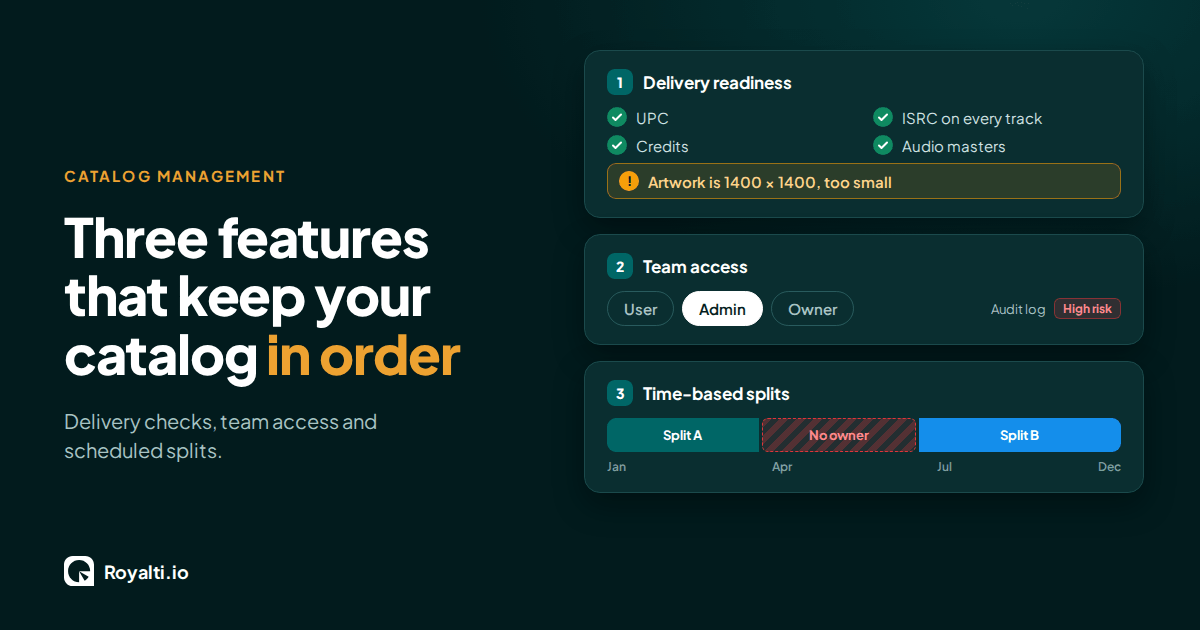
Royalti.io: Three Features That Keep Your Catalog in Order
Delivery checks that stop bad releases, team access you can trust, and splits that change on schedule. Here is how each one works in Royalti.io
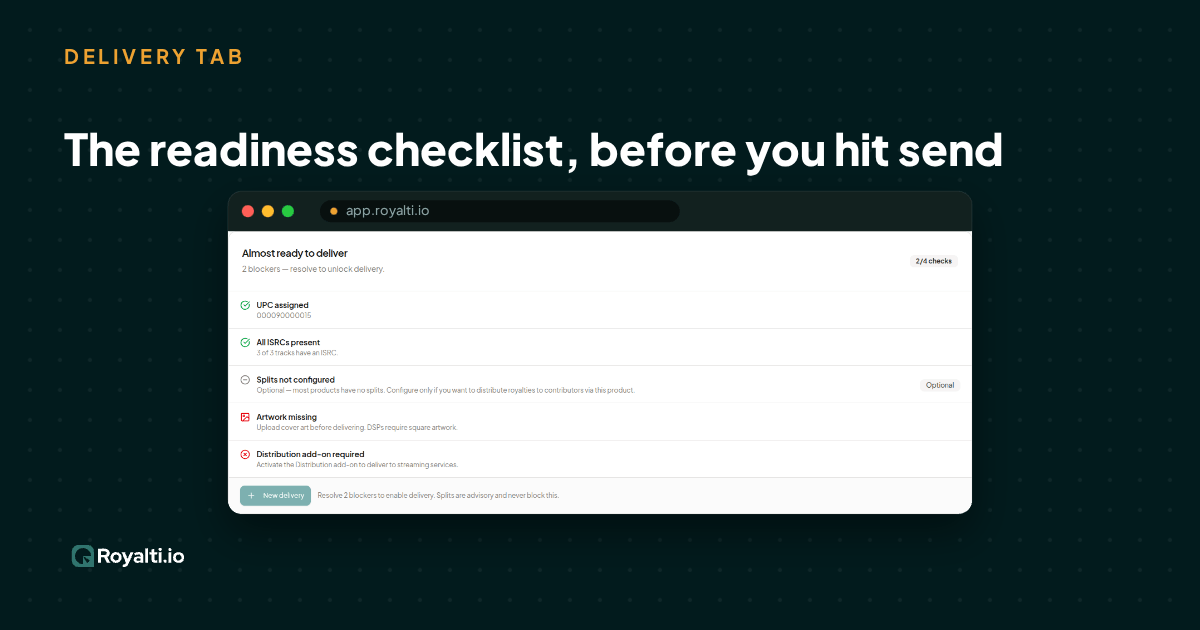
Royalti.io: How We Rebuilt DDEX Delivery
A release can fail on its way to stores without anyone noticing. Here is what broke in our DDEX delivery, how we fixed it, and what you can check first.
AI and Creator Consent 1: What Creator Groups Want From AI Music Deals
Learn why creator groups are demanding consent, fair compensation and transparency from AI music deals
Comments
No comments yet. Be the first to comment!