The Hidden Cost of Unclaimed Royalties
There may be royalties with your name on them sitting unclaimed. So we made a post explaining just what black box royalties are and what you can do about them.
Let’s be honest, you have probably heard about black box royalties mentioned in conversation, and everyone, ourselves included, seems obsessed with preventing it. But, do you even know what it means? Do you know what it costs you if your royalties were to end up in a black box? Because if you did, you would be just as obsessed with preventing it. In this post, we will explore the true cost of unclaimed royalties.
A Gold Mine In Its Own Right
€5 billion in just one year. That is how much was accrued from digital royalties across all creative sectors in 2024, with music pulling the majority of that figure, the first time digital music royalties have reached that threshold. And that is just digital collections, not touring, merchandising, or any other revenue source. These figures are not slowing down either; streaming subscriptions are predicted to reach one billion globally by 2027.
What these numbers speak to is clear: the music royalty economy is a healthy, active one. The problem, though, is that hidden deep within this system is a pool of money that has been earned but never paid to the artists and songwriters who generated it. That is what is referred to as “Black box” royalties.
Imagine it, somewhere right now, as an artist, songwriter, or rights holder, there is money with your name on it. But nobody knows it's yours, so there is nowhere to send it.
The Void that is Black Box
The black box is a music industry term describing unclaimed or unallocated royalties owed to creators and rights holders. These royalties might have been generated from diverse sources like streaming, radio play, downloads, et cetra, but their rightful owners are unknown or cannot be identified. It is a failure in the system where usage data cannot be matched to a registered work, and the registered work cannot be matched to a verified creator or rights holder.
So what you are left with is a situation where a song is streamed, performed, broadcast, or synced to a film, royalties are generated and collected by PROs and collection societies, but the rightful owners cannot be found.
Unclaimed Means Unpaid
Since the money is unclaimed, it simply sits with the streaming platform or collection organisation. But it cannot sit there forever. Typically, the waiting period is two to three years. After that, depending on the applicable rules, that money is redistributed to top earners within that collection organisation or streaming platform.
But what about recovery? That used to be a very difficult and opaque endeavour. Imagine searching through a pool of accrued income across multiple sources, possibly over extended periods, with little to no identifiable information. Thankfully, technology has come a long way; now, some platforms can scan streaming services, collection societies, and registries to identify missing and unclaimed royalties.
However, the goal is not to get to that point. Because while the best-case scenario is tracing some of the money before it is redistributed among other creators, the worst-case scenario is a catalog title with over 100 million streams wrongly claimed, generating income that will never reach the correct rights holder. And yes, that has happened, but in that case, it was recovered only after the wrongful claim had been identified and resolved, income that could easily have been lost permanently. That is the true cost of unclaimed royalties. Money that cannot be matched does not simply disappear; it is transferred to top-earning creators, to the disadvantage of emerging artists.
How Royalties Get Lost
Royalties become mismatched and fall through the cracks when songs are not registered, when metadata is incomplete, when information provided during registration is incorrect or mispelled, even something as small as an artist's name, and when split sheets were never signed. It is essentially any situation that makes establishing the ownership of a work unclear.
What You Can Do
Preventing black box royalties starts with understanding exactly how they occur and then closing every gap that makes them possible.
The first is to get your work registered locally with a Collection Management Organisation. For international collection, you can authorise an organisation with affiliations with collection societies abroad, which can ensure your royalties are collected on your behalf across territories. Register your works correctly: name, title and all.
Next, address metadata errors. Incorrect titling; absent or incorrectly entered ISRC codes are the kinds of errors that look small but cost you in the long run. An absent ISRC code, for instance, is a broken link in the tracking mechanism that should connect stream counts to the rights holder.
Resolve split conflicts before the beat is even finished. This can be done with a simple split sheet that states who did what and who owns what. Because where two or more parties have registered different ownership percentages for the same work, they are priming a dispute that must be resolved before a single royalty kobo can be paid out.
And lastly, be proactive. If royalties have not been reported on a work for a while, chances are that something is amiss. Because royalties can typically be retroactively claimed within a limited window only, it is important that abnormalities are spotted, traced and resolved quickly. That is where platforms like Royati.io make a difference, ensuring that royalty tracking, catalog management and royalty administration are accessible for every music creator and rights holder.
Black box royalties are the predictable consequence of incomplete documentation, unregistered works, and passive management. Every step you take towards clarity takes you away from that pool of lost income.
About the author
Keep reading
All posts →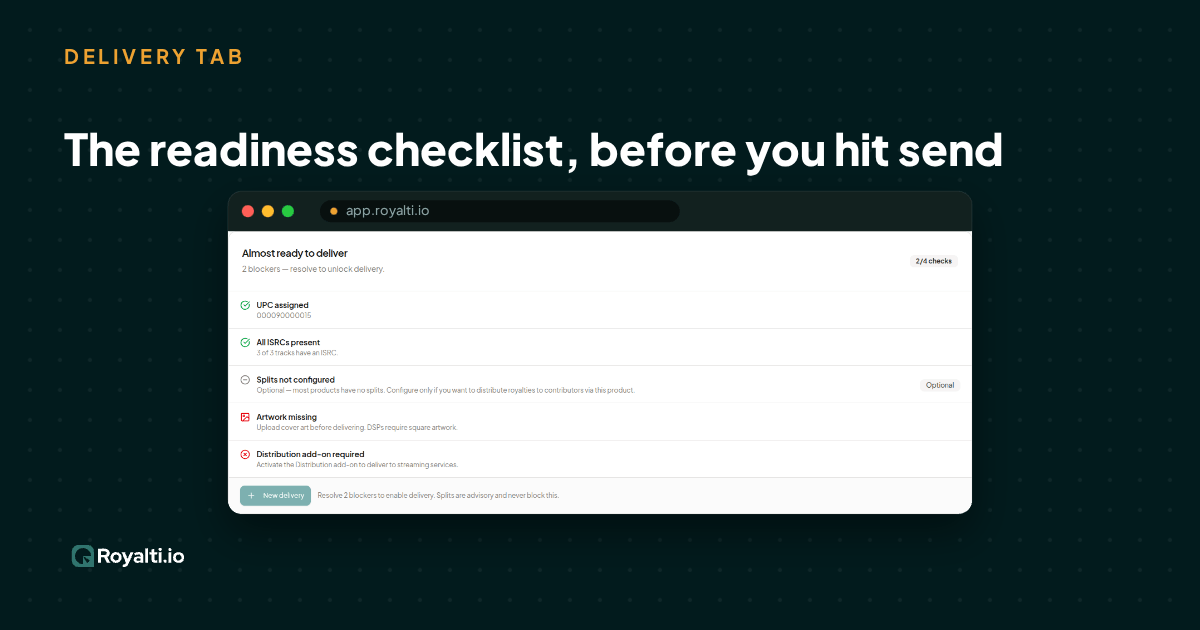
Royalti.io: How We Rebuilt DDEX Delivery
A release can fail on its way to stores without anyone noticing. Here is what broke in our DDEX delivery, how we fixed it, and what you can check first.
AI and Creator Consent 1: What Creator Groups Want From AI Music Deals
Learn why creator groups are demanding consent, fair compensation and transparency from AI music deals
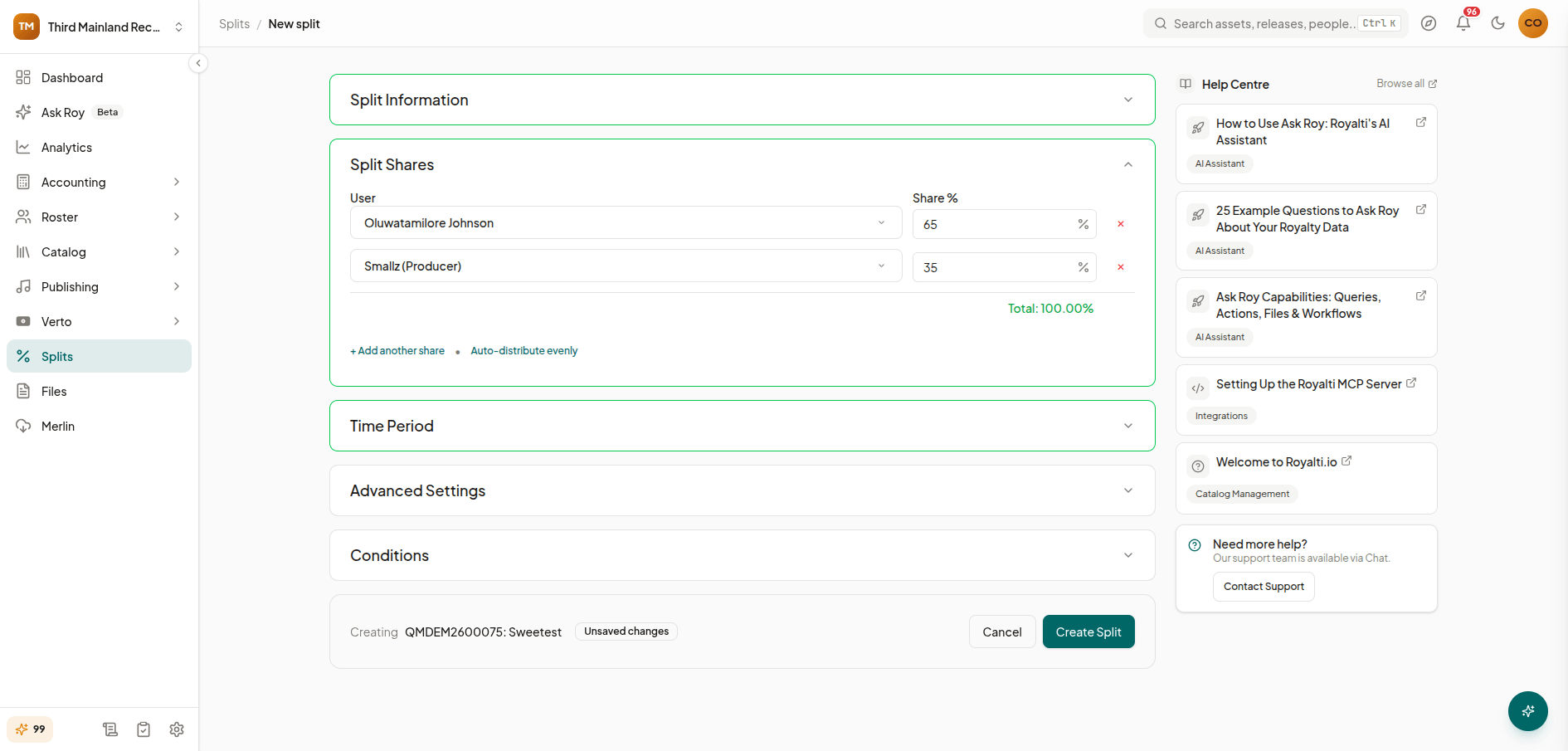
Time-Based Splits: How to Schedule Ownership Changes on Royalti.io
When a split change depends on someone remembering to make it, it gets missed. Royalti.io's time-based splits let contract terms live inside the system that pays out against them
Comments
No comments yet. Be the first to comment!